

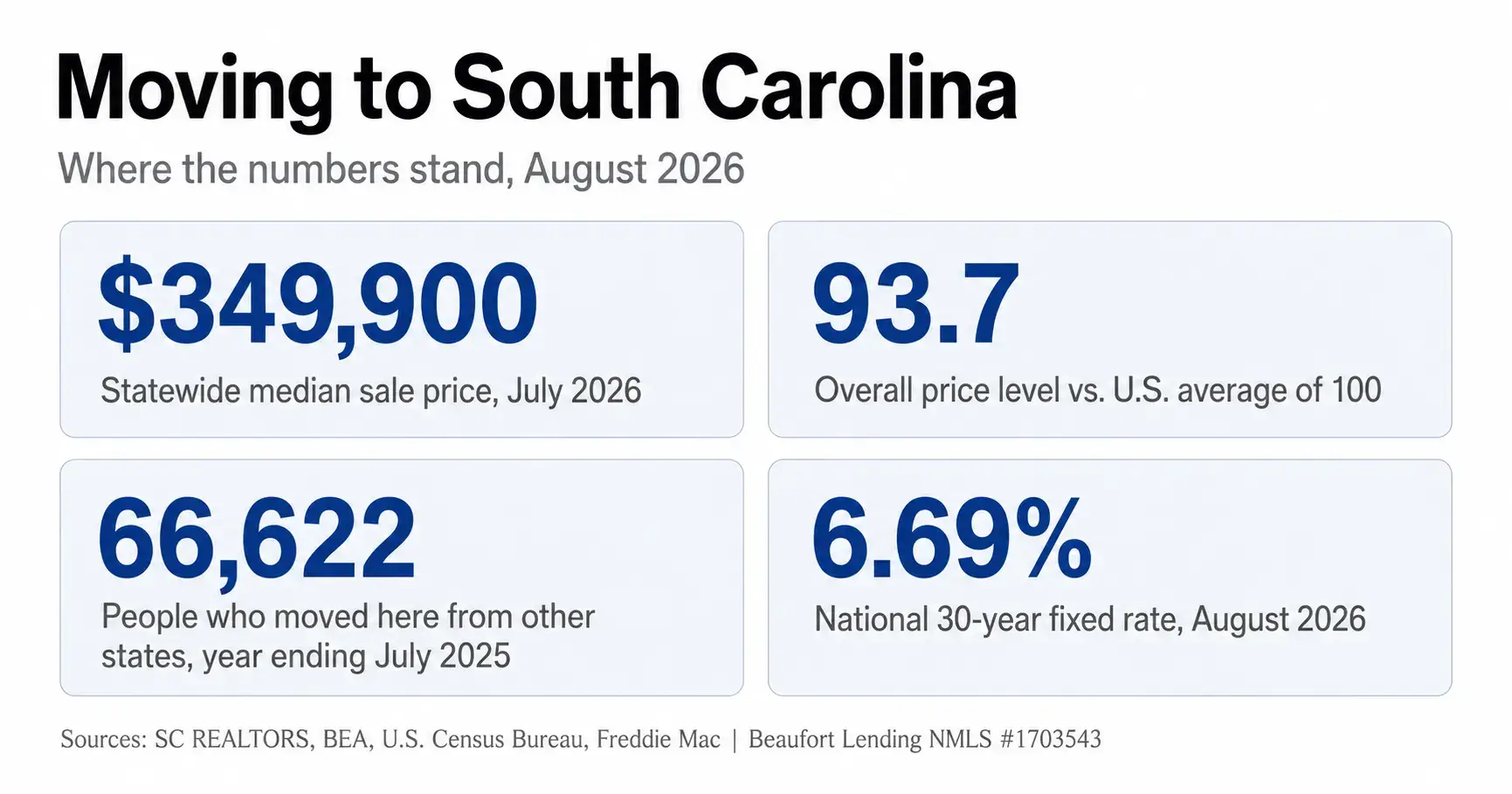
There is a reason more people moved here from other states last year than to anywhere else in the country. For most households coming from the Northeast, housing and property taxes cost meaningfully less, and the money freed up is real. How much you keep depends on which market you choose and how the home is insured, and that is a question with a clear answer, not a mystery. Here is what drives it.
- Overall prices run about 6% below the national average. South Carolina's 2024 regional price parity was 93.7 against a U.S. average of 100, per the Bureau of Economic Analysis. New Jersey was 108.8, New York 107.9, Massachusetts 105.8, Connecticut 103.6, and Pennsylvania 97.6, so the size of the gap depends on where you are leaving.
- Housing is where the difference shows up most. The statewide median sale price was $349,900 in July 2026, per South Carolina REALTORS®, and inland markets like Columbia and Greenville sit below that.
- Property taxes on a home you live in are genuinely low. Owner-occupied homes get a 4% assessment ratio and a full exemption from school operating millage. You do have to apply for it with the county assessor, and it is one of the easiest wins available to a new resident.
- Insurance is the line item to price early, especially near the water. Coastal policies work differently than what you are used to up north: percentage-based wind deductibles, separate wind and hail coverage in some areas, flood coverage where the map requires it. None of it is a dealbreaker. It just belongs in the budget from day one instead of week six.
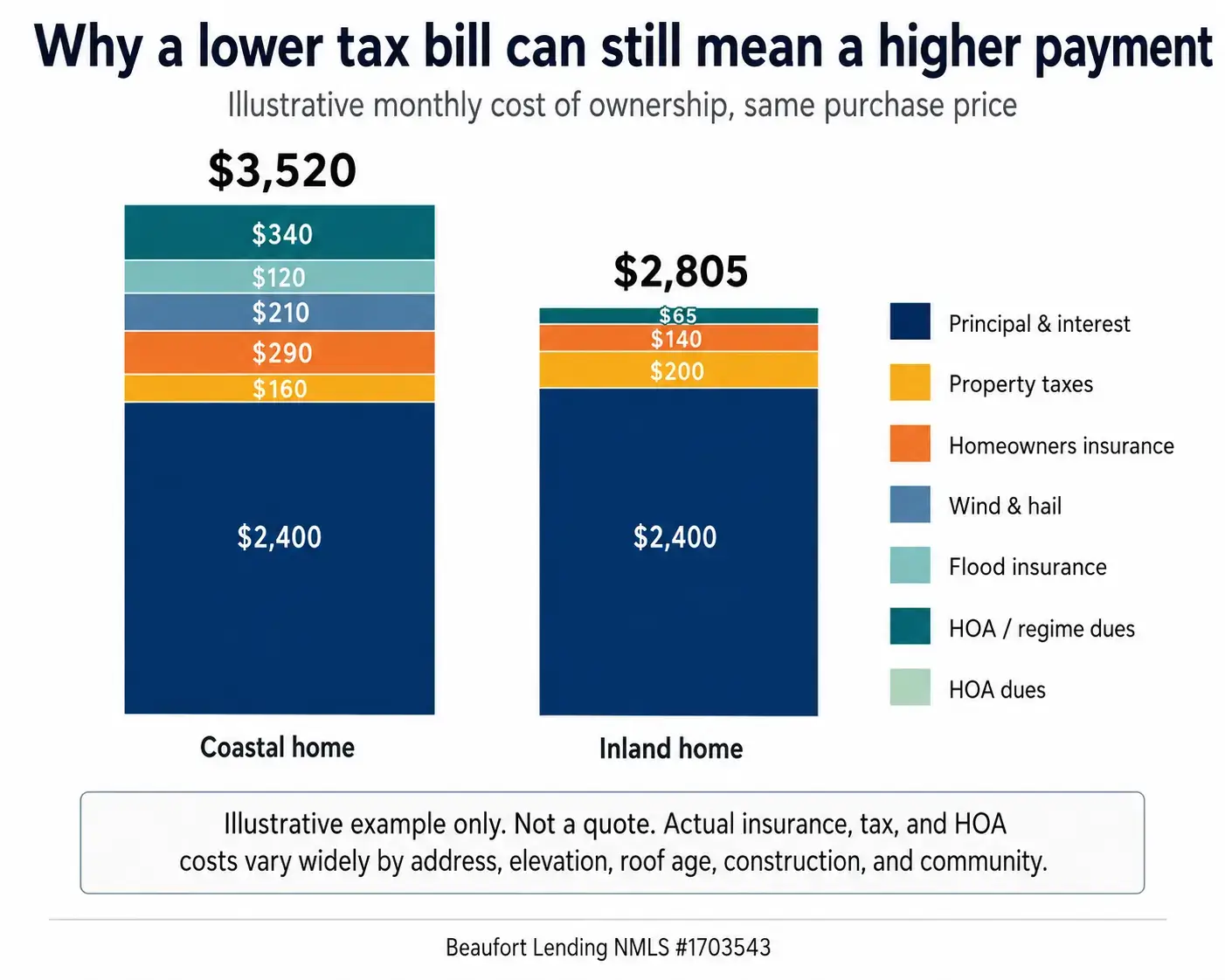
- Coastal and inland are two different budgets, and both work. The coast buys you the water; inland buys you a lower monthly payment. Knowing which one fits your number is most of the decision.
- Start the financing conversation 6 to 12 months out. Not because you need a loan that early, but because it tells you which markets your budget comfortably reaches once taxes and insurance are in the payment, and how to time the sale of your current home.
And if you would rather just ask somebody: we have lived and lent in South Carolina our whole lives, from the Lowcountry to the Upstate, and we will give you real numbers for a real address, including the taxes and insurance, before you ever fill out an application. Call or text 843-524-2404 or send us your scenario.
By Benji Gecy, NMLS #302188 | Beaufort Lending, NMLS #1703543 | Last updated: August 2026

Is moving to South Carolina a good idea in 2026?
For a lot of households, yes, and the migration numbers say plenty of people have already decided. Between July 1, 2024 and July 1, 2025, South Carolina gained 66,622 more residents from other states than it lost, and the state's population grew 1.5%, faster than any other state in the country, according to the U.S. Census Bureau's Vintage 2025 state population estimates. Domestic migration, not births, drove nearly all of it.
That is a useful signal, not an argument. Plenty of people move somewhere and find the budget did not work the way they pictured. So here is the honest ledger.
What usually does get cheaper
Housing and property taxes, mostly, and those happen to be the two biggest lines in the budget. The mechanism on taxes is the part worth knowing: South Carolina assesses an owner-occupied legal residence at 4% of market value and exempts it entirely from school operating millage. That combination, not one low rate, is what produces the small bills. State income tax is modest as well. Under H. 4216, signed March 30, 2026, South Carolina taxes income under $30,000 at 1.99% and income of $30,000 and above at 5.21% minus $966, beginning with the 2026 tax year, per the South Carolina Department of Revenue.
What to budget for that you may not be used to
- Insurance near the water, including a separate flood policy wherever the map requires one. This is the most common budget miss I see with relocating buyers, and the next section breaks down why.
- HOA, regime, and amenity fees in the planned communities and island neighborhoods that draw the most relocating buyers.
- Vehicle costs. South Carolina levies county property tax on personal vehicles, and you must pay that bill before you can register the car, per the SCDMV.
- Wages, in some fields. Cost of living is lower here in part because incomes are lower. If your job does not move with you, price the local salary before you price the house.
- Summer. June through September is hot and humid, hurricane season runs June 1 through November 30, and coastal preparation is a real annual routine, not a formality.
What does it cost to live in South Carolina?
Start with the number that covers everything at once, then break out the pieces that vary the most by address.
The Bureau of Economic Analysis publishes regional price parities, which compare overall price levels in each state against a national average of 100. For 2024, released February 19, 2026, South Carolina came in at 93.7. That means the same basket of goods and services costs roughly 6% less here than the U.S. average.
That single number hides a lot, though, because the components move in different directions.
Housing
Statewide, the median sale price was $349,900 in July 2026 and flat year over year, with homes taking a median 71 days to sell and 4.4 months of supply on the market, per South Carolina REALTORS®. Individual markets range widely around that figure. See the market-by-market table further down.
On financing costs, the national benchmark 30-year fixed rate averaged 6.69% in Freddie Mac's Primary Mortgage Market Survey for the week of August 6, 2026. That survey reflects conventional, conforming loans for borrowers with strong credit putting 20% down; your own rate depends on your credit, down payment, loan type, property, and the day you lock.
Property taxes
South Carolina's property tax system has three moving parts: the appraised value, the assessment ratio, and the local millage. The ratio is where relocating buyers gain or lose the most.
- 4% ratio: legal residence. Your primary residence and up to five contiguous acres are assessed at 4% of fair market value, once the county assessor approves your application.
- 6% ratio: everything else. A second home, vacation home, or other personal-use real property is assessed at 6%.
- School operating exemption. An owner-occupied residence that qualifies as a legal residence is 100% exempt from property taxes imposed for school operating purposes. That exemption does not apply to millage for repaying general obligation debt, and it is not available on a second home.
- You must apply. The residential classification is generally not available unless the owner applies to the county assessor before the first penalty date for taxes due, January 16. No application is needed for the school operating exemption itself, but the 4% ratio must be applied for.
- You must certify residency. As part of the application, you certify that the home is where you are domiciled, that neither you nor a household member claims legal residency in another jurisdiction for any purpose, and that no one in the household claims the 4% ratio on another residence.
Homeowners insurance, wind, and hail
Inland, South Carolina homeowners insurance behaves much like it does anywhere else. Along the coast, three things change:
- The deductible structure. Coastal policies commonly carry a separate hurricane or windstorm deductible expressed as a percentage of the dwelling's insured value rather than a flat dollar amount. On a $500,000 dwelling limit, the difference between a 1% and a 5% deductible is $20,000 of your own money after a storm.
- Who writes the wind coverage. Some coastal properties cannot get wind and hail coverage in the standard market and are written through the South Carolina Wind and Hail Underwriting Association, the state's residual wind pool, which the Department of Insurance points buyers to directly. A wind pool policy covers wind and hail only, so it has to be paired with a separate homeowners or dwelling policy.
- When you can buy it. Carriers stop binding new coverage once a storm is named. That has direct consequences for a summer or fall closing date, and it gets its own section below.
I am not going to quote you an average premium, because averages are close to useless at the address level here. Two houses on the same street, one with a 20-year-old roof and one rebuilt to a fortified standard, can price very differently. Get real quotes on the specific property before your inspection contingency expires, not after.
Flood insurance
Flood is not covered by a homeowners policy. It is a separate policy, and in some cases it is mandatory: you are required to carry flood insurance if the home is in a Special Flood Hazard Area and you have a government-backed mortgage, per FEMA's National Flood Insurance Program. Some lenders require it outside mapped high-risk zones as well.
You can look up any address on FEMA's Flood Map Service Center before you make an offer, and it takes about a minute. Flood coverage also carries a waiting period that can move a closing date, which the storm-timing section below covers.
HOA, regime, and condominium fees
In the neighborhoods that attract the most relocating buyers (Hilton Head Island plantations, Bluffton and Beaufort planned communities, Myrtle Beach oceanfront condo buildings), monthly dues are a material part of the payment, not a rounding error. Ask for the current budget, the reserve study, the dues history, and whether any special assessment is pending.
For condos specifically, the association's financials also affect whether the unit is financeable at all. Lenders review the project: owner-occupancy mix, delinquency rates, reserves, litigation, master insurance deductibles, and short-term rental activity. A unit can be perfectly nice and still be a hard loan. If you are shopping condos on the coast, read the guide to condo and condotel financing on the Grand Strand before you fall in love with a building.
Utilities, transportation, and everyday costs
Summer electric bills are the seasonal reality: air conditioning runs hard from May through September, and an all-electric home with an older heat pump can surprise you. Ask the listing agent for 12 months of utility history rather than a monthly average.
On the car side, South Carolina charges county property tax on personal vehicles, assessed at 6%, and the SCDMV will not register your vehicle until that bill is paid to the county treasurer. Outside the downtown cores of Charleston, Greenville, and Columbia, this is also a two-car state.
Why your property tax bill will not match the seller's
This is the most common budgeting mistake I see out-of-state buyers make, and it costs real money.
South Carolina caps increases in appraised value at 15% within a five-year reassessment cycle. That cap protects long-time owners. It does not protect you. It does not apply in the year a property first becomes subject to tax after an assessable transfer of interest, which is what a sale is, per the SCDOR property tax guidance cited above.
In plain terms: when you buy, the county reappraises, and your bill is based on what the property is worth now, not on what the seller had been paying. On a home that has been in one family for fifteen years, the gap between the taxes shown on the listing and your first actual bill can run into thousands of dollars a year. Treat the listing figure as history, not as your budget.
Two things to do before you write an offer. Ask the county assessor how the property will be assessed after the transfer. And confirm whether you will qualify for the 4% legal residence ratio in your first year, because a home sitting at 6% without the school operating exemption is a materially different monthly payment.
Why a named storm can delay your closing
If you are buying near the South Carolina coast between June and November, this belongs on your calendar rather than in the fine print.
Once a storm is named and looks likely to affect the area, insurance carriers declare a moratorium on new policies and on coverage changes to existing policies, per the South Carolina Department of Insurance. No bound homeowners policy means no closing. A system that never makes landfall here can still freeze binding for several days.
Flood coverage runs on its own clock. There is a 30-day waiting period for NFIP coverage to take effect, per the same source. If the property sits in a Special Flood Hazard Area and you are financing it, that is 30 days to plan around, not 30 days you can compress.
The practical version: during hurricane season, get insurance quoted and bound as early as your contract allows, and leave slack in the rate lock. The buyers who get hurt are the ones who treated insurance as a last-week item.
How does South Carolina compare with the Northeast?
Two comparisons matter more than the rest: overall price levels, and what you actually pay in property tax on a home you live in.
Overall price levels
| State | 2024 regional price parity (U.S. = 100) | Difference vs. South Carolina |
|---|---|---|
| South Carolina | 93.7 | Baseline |
| New Jersey | 108.8 | about 16% higher |
| New York | 107.9 | about 15% higher |
| Massachusetts | 105.8 | about 13% higher |
| Connecticut | 103.6 | about 11% higher |
| Pennsylvania | 97.6 | about 4% higher |
Source: U.S. Bureau of Economic Analysis, Regional Price Parities by state, 2024, released February 19, 2026. See BEA Regional Price Parities by State and Metro Area. Differences are approximate and describe overall price levels, not any individual household's budget.
Notice Pennsylvania. A household moving from Bucks County is looking at a roughly 4% overall difference, not the 15% a New Jersey or New York household sees. That is the first place I push back when someone tells me the move will pay for itself.
Property taxes, county by county
State averages blur too much here, so compare counties. These are median property taxes actually paid by owner-occupied households, alongside median home value.
| County | Median home value | Median property taxes paid | Effective rate |
|---|---|---|---|
| Beaufort County, SC | $455,600 | $2,174 | 0.50% |
| Charleston County, SC | $489,100 | $1,901 | 0.40% |
| Greenville County, SC | $299,000 | $1,512 | 0.51% |
| Horry County, SC (Myrtle Beach) | $287,700 | $944 | 0.38% |
| Richland County, SC (Columbia) | $242,800 | $1,637 | 0.64% |
| Bergen County, NJ | $623,000 | $10,000+ | 1.89% |
| Nassau County, NY | $684,700 | $10,000+ | 1.72% |
| Westchester County, NY | $663,200 | $10,000+ | 1.84% |
| Middlesex County, MA | $727,800 | $7,501 | 1.01% |
| Capitol Planning Region, CT | $323,700 | $6,454 | 1.91% |
| Bucks County, PA | $445,700 | $5,826 | 1.20% |
Source: Tax Foundation, Property Taxes by State and County, 2026, using U.S. Census Bureau 2024 five-year estimates. "$10,000+" is how the underlying Census data is topcoded. These are county medians across all owner-occupied homes, not a quote for any specific property.
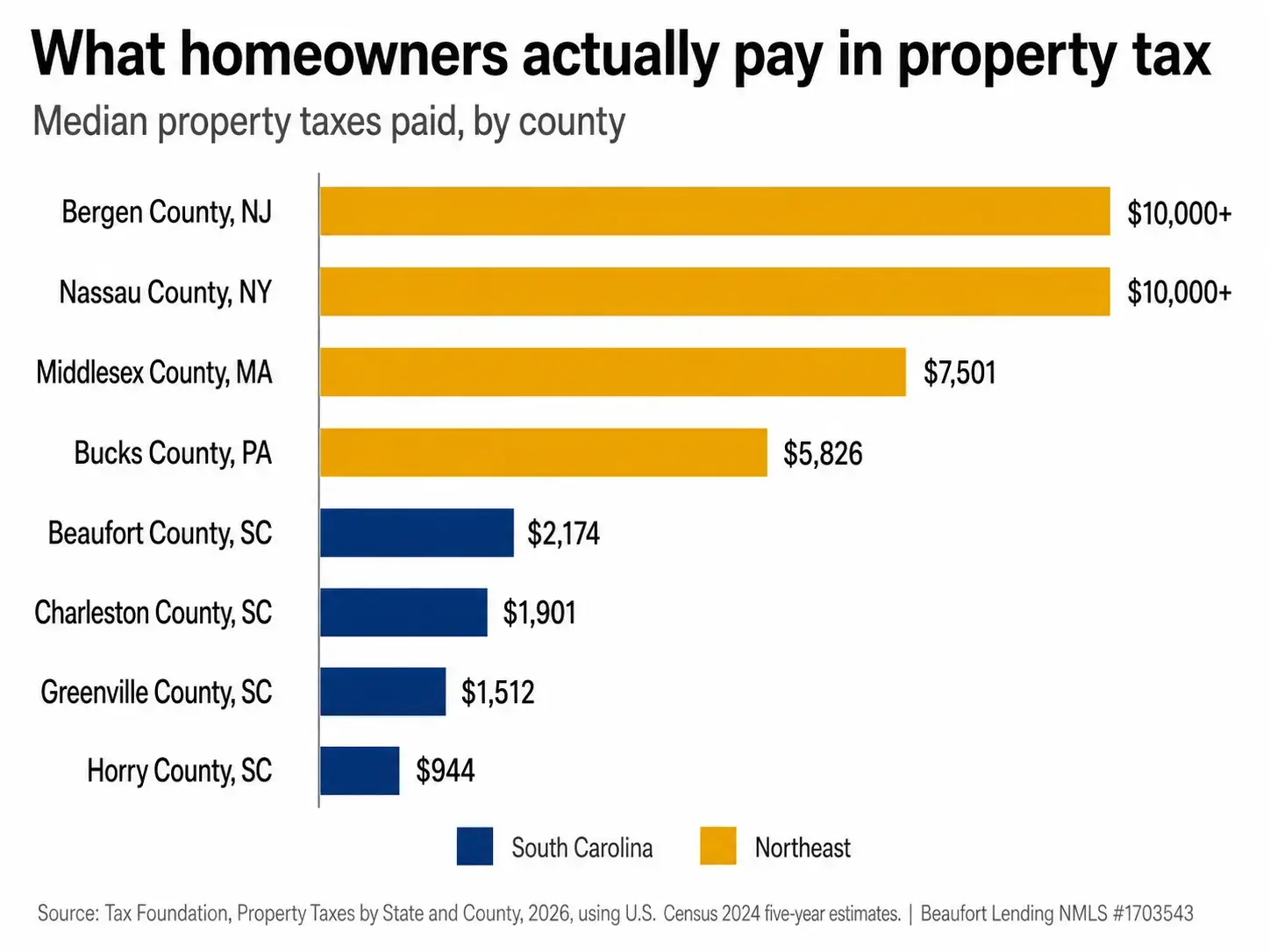
Two things to hold onto when you read that table. The South Carolina figures are low partly because they reflect owner-occupied homes getting the 4% ratio and the school operating exemption. A second home in the same county would not look like that. And your own bill will be based on your purchase price after reassessment, so a home priced well above the county median will carry a bill well above the county median.
What happens when you convert Northeast equity into a South Carolina purchase
This is where most relocation budgets are actually decided. If you are selling a home in a high-priced Northeast market and buying in an inland South Carolina market, the equity often covers a much larger share of the purchase, sometimes enough to change the loan program, eliminate mortgage insurance, or shrink the loan to where the payment is comfortable at current rates.
But it is not automatic, it is not tax advice, and the sequencing matters as much as the amount. We keep the detailed version of that discussion in a separate article: how to move equity from a Northeast sale into a South Carolina purchase. If you are retirement-aged and want the new home before the old one sells, the buy-before-you-sell approach for retirees covers that specific path.
Where should you move in South Carolina?
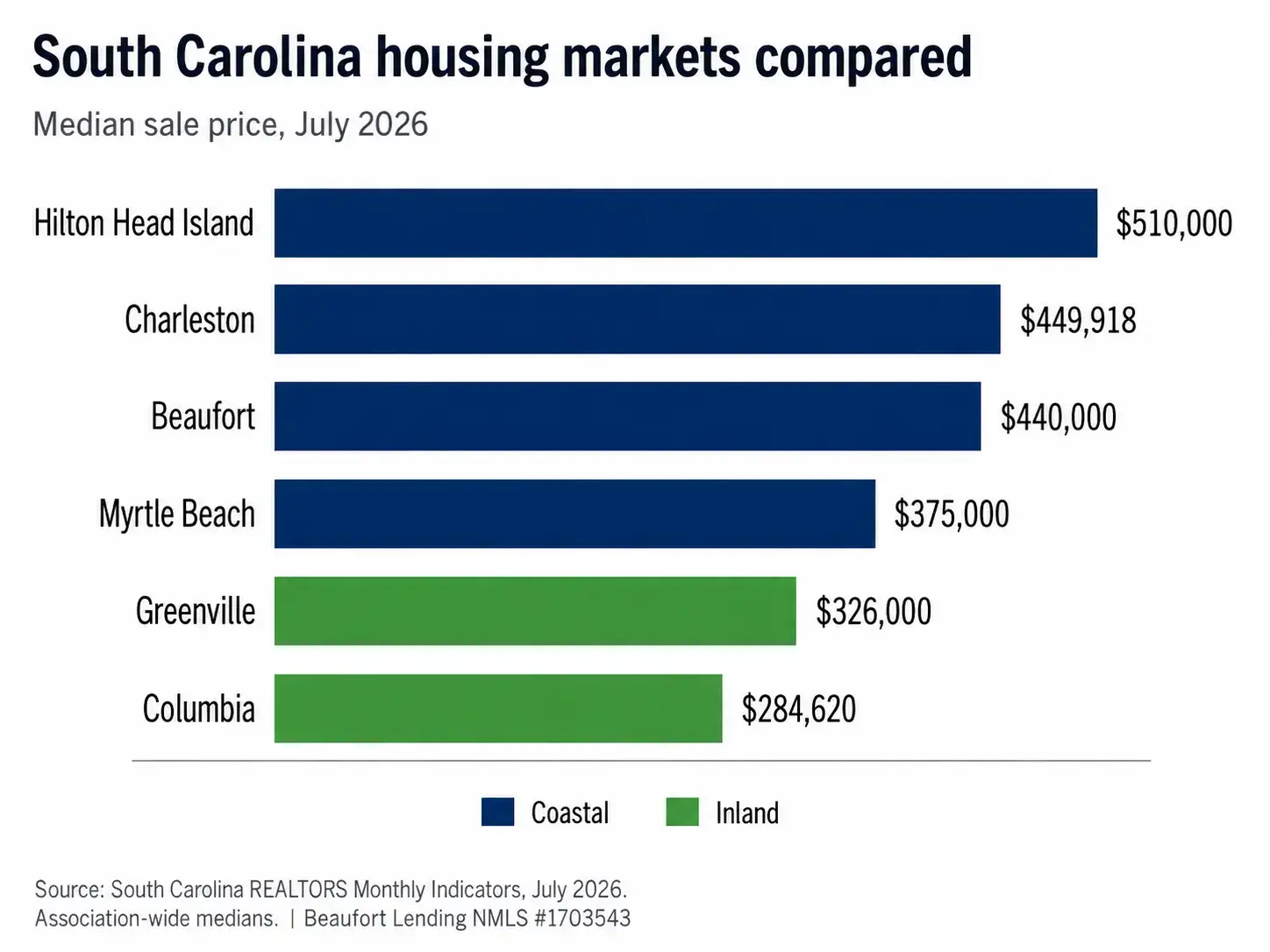
There is no ranking that survives contact with an actual household's priorities. What follows is the same market data pulled from one consistent source and one consistent month, so the comparison is fair, plus the ownership-cost issues that separate these places.
| Market | Median sale price, July 2026 | Coastal or inland | Lifestyle | Economic character | Ownership-cost considerations | Best suited for |
|---|---|---|---|---|---|---|
| Beaufort (Beaufort–Jasper) | $440,000 (+3.5%) | Coastal | Historic small town, marshfront, slow pace | Military (MCRD Parris Island, MCAS Beaufort), healthcare, tourism | Wind and flood exposure; some neighborhoods carry HOA dues; 130 median days on market means time to negotiate | Buyers who want the Lowcountry without island pricing; military and VA buyers |
| Charleston (Charleston Trident) | $449,918 (+4.6%) | Coastal | Historic city, restaurants, beaches, walkable core | Port, aerospace and manufacturing, tech, tourism, healthcare | Tightest market of the six at 3.6 months supply and 47 days; flood zones vary block by block downtown | Buyers who need an urban job market and will pay for it |
| Columbia (Consolidated MLS) | $284,620 (+0.7%) | Inland | Capital city, university town, lakes and rivers | State government, University of South Carolina, Fort Jackson, healthcare, insurance | Lowest entry price of the six; no coastal wind pricing; inventory up 28.8% year over year | Budget-first buyers and anyone prioritizing stable, non-tourism employment |
| Greenville (Greater Greenville) | $326,000 (−1.7%) | Inland | Revitalized downtown, foothills, trail system, four visible seasons | Advanced manufacturing, automotive, corporate headquarters, healthcare | No coastal wind or flood premium in most of the county; city-limits pricing runs far above the association-wide median | Households wanting an inland city with a strong job base and mild weather risk |
| Hilton Head Island (Hilton Head Area) | $510,000 (−7.3%) | Coastal / island | Resort island, golf, beaches, gated plantations | Tourism, hospitality, healthcare, retirement services | Highest combined insurance, HOA, and regime cost of the six; 125 median days on market; condo financing needs project review | Second-home and retirement buyers who have budgeted the full carrying cost |
| Myrtle Beach (Coastal Carolinas) | $375,000 single-family (0.0%); $231,000 condo (−3.3%) | Coastal | Beach town, golf, high seasonal tourism | Tourism, hospitality, retail, healthcare, retirement | Lowest coastal entry price, especially condos; condo and condotel financing rules are strict; wind and flood exposure | Budget-conscious coastal buyers and investors who understand condo lending |
Source: South Carolina REALTORS® Monthly Indicators, July 2026, drawn from each area's REALTOR® association or MLS and current as of August 7–10, 2026. Percentages are year-over-year changes in median sale price. Statewide median was $349,900, flat year over year.
How to narrow it to two markets
- If the job comes first: Charleston, Greenville, and Columbia have the deepest non-tourism employment. Beaufort's economy leans heavily military; Hilton Head and Myrtle Beach lean heavily hospitality.
- If the monthly payment comes first: Columbia and Greenville, in that order. Inland markets avoid coastal wind pricing entirely in most areas.
- If the water comes first: Beaufort is the value entry to the Lowcountry, Myrtle Beach the value entry to the beach, Hilton Head the premium version of both.
- If you are buying with a VA loan and relocating on orders: the Beaufort and Parris Island corridor is built around that timeline. Start with home financing around Parris Island and MCAS Beaufort.
- If you want to see how one market really feels day to day: our local reads on what draws people to Beaufort and what relocating buyers find in Charleston go deeper than any table can.
Explore Lowcountry homes
Thinking about the Lowcountry? You can browse current homes for sale in Beaufort, Bluffton, and Hilton Head Island through Discover Low Country Life, a local South Carolina real estate website operated by Christina "Christy" Gecy, a licensed South Carolina real estate professional, and my wife.
Disclosure: Christina Gecy is my spouse. I am telling you that because you should know it, not because you should act on it. You are free to work with any real estate professional and any mortgage provider you choose. Using Discover Low Country Life is not required to obtain financing from Beaufort Lending, and it does not affect your rate, your terms, your costs, or how your loan is reviewed. It is simply a local search tool for the three markets we know best.
Coastal or inland: which actually costs less to own?

Buyers usually frame this as a lifestyle question. It is also a math question, and the math is not always what the sticker price suggests.
| Factor | Coastal (Beaufort, Charleston, Hilton Head, Myrtle Beach) | Inland (Greenville, Columbia) |
|---|---|---|
| Purchase price | Higher in three of the four; Myrtle Beach condos are the exception | Lower entry point statewide |
| Homeowners insurance | Percentage-based wind or hurricane deductibles are common; wind and hail may need a separate policy or the state wind pool | Conventional deductible structures in most areas |
| Flood insurance | Required in a Special Flood Hazard Area with a federally backed mortgage; 30-day NFIP waiting period | Usually optional, but river and creek flooding is real, so check the map anyway |
| HOA / regime fees | Frequently significant, especially on islands and in gated communities and condo buildings | Common in newer subdivisions, generally lower |
| Maintenance | Salt air, humidity, and storm exposure shorten the life of roofs, HVAC, decks, and exterior finishes | Standard Southeast maintenance; heat and humidity still drive HVAC wear |
| Job market | Tourism and hospitality heavy, with military in Beaufort and the port and aerospace in Charleston | Manufacturing, corporate, government, healthcare, higher education |
| Recreation | Beach and water access; golf; boating | Lakes, rivers, mountains within a short drive; coast is 3–4 hours away |
| Storm preparation | An annual routine: evacuation planning, shutters, insurance timing around named storms | Inland wind and rain impacts happen, but preparation is lighter |
Can you get pre-approved before you move to South Carolina?
Yes. Where you currently live does not disqualify you. A lender is looking at your income, credit, assets, and debts, not your mailing address. What does change when you are moving from out of state is how a few pieces get documented.
- Remote documentation. Applications, disclosures, and most closings can be handled electronically. In-person requirements vary by state and closing agent, so confirm early what has to be signed in person.
- Employment continuity. If you are keeping your current employer and working remotely, expect the file to document that the arrangement continues after you move, often in writing from the employer.
- Job-offer income. Starting a new South Carolina job usually means providing an executed offer letter or contract with start date, pay, and terms. Rules vary by loan program and lender, and some scenarios require a first pay stub before funding.
- Self-employment. If your income is from a business, the review is heavier and the timeline is longer. Start earlier.
- Assets. Down payment and reserve funds have to be sourced and seasoned. If the money is coming from the sale of your current home, the settlement statement usually becomes the document that matters.
- Occupancy. Primary residence, second home, and investment property carry different terms, different down payment expectations, and different insurance requirements. You state your intended occupancy in writing, and it should match your actual plan.
None of that is a guarantee of approval. Every file is reviewed on its own facts, and program requirements change. What it is, is a list of the things worth sorting out before you are under contract with a closing date.
If you want to see how the state's programs are organized before you talk to anyone, our overview of South Carolina financing paths by goal lays them out by what you are trying to do rather than by product name. Two that come up constantly with relocating buyers: USDA financing in areas designated as rural, which covers more of South Carolina than people expect (you do have to check the specific address on USDA's eligibility site), and jumbo financing above conforming limits, which is where a lot of Hilton Head and Charleston purchases land.
Tell Us About Your Move and We Will Do the Legwork
Every relocation has its own moving parts: a house to sell, a start date, a school year, a closing that has to line up across two states. Send us the details and we will come back with the practical answers, not a sales pitch.
- Real rate options for your credit, your down payment, and the property type you are actually shopping.
- A payment that includes the whole picture, with taxes at the right assessment ratio and a realistic insurance figure for that address.
- Help sequencing the move, so the sale up north and the purchase down here do not fight each other.
- The inside scoop from lifelong locals. The Beaufort Lending team grew up here and has been lending here since 1997, from the Lowcountry to the Upstate. We know which neighborhoods flood, which HOAs surprise people, and which closings need extra runway in storm season.
Should you sell your current home before buying in South Carolina?
There is no universally right answer. There is a right answer for your equity position, your risk tolerance, and your calendar. Here is the framework I walk relocating clients through.
| Approach | What it solves | What it costs you | Fits best when |
|---|---|---|---|
| Sell first, then buy | Certainty about proceeds; removes the old mortgage from your debt-to-income ratio; makes your offer clean and non-contingent | Temporary housing, storage, and usually two moves; you shop under time pressure | Most of the down payment depends on the sale, or your DTI cannot support both payments |
| Buy first, then sell | One move; time to shop carefully; you are not renting in a strange city | You must qualify carrying both payments, or use an equity or bridge tool; you carry two properties until the old one closes | Strong income and reserves, or substantial equity you can access before the sale |
| Coordinate both closings | Cheapest outcome; proceeds fund the purchase directly; one move | Hardest to schedule; a delay on either side cascades; across two states, two closing customs, and possibly a storm-season insurance moratorium | Both transactions are stable, and both sides will cooperate on dates |
| Use existing equity for the down payment | Lets you buy before selling without draining savings | Adds a payment and has to be arranged before your current home is listed; not available in every situation | You have meaningful equity and want to make a non-contingent offer |
| Keep both properties | Preserves a Northeast asset; may generate rental income | Two sets of taxes, insurance, and maintenance; qualifying is harder; landlording from 800 miles away is a real job | The old home genuinely works as a rental and you have the reserves for both |
The pieces that decide it are usually contingencies, liquidity, debt-to-income ratio, temporary housing costs, and reserves. If you want to explore borrowing against the equity in your current home rather than waiting on the sale, the general mechanics of second mortgages and home equity lines are covered separately, and the full sequencing playbook lives in our article on moving Northeast equity into a South Carolina purchase.
Your moving to South Carolina checklist
Organized by how far out you are. If you are already inside 90 days, work backward from the last block.
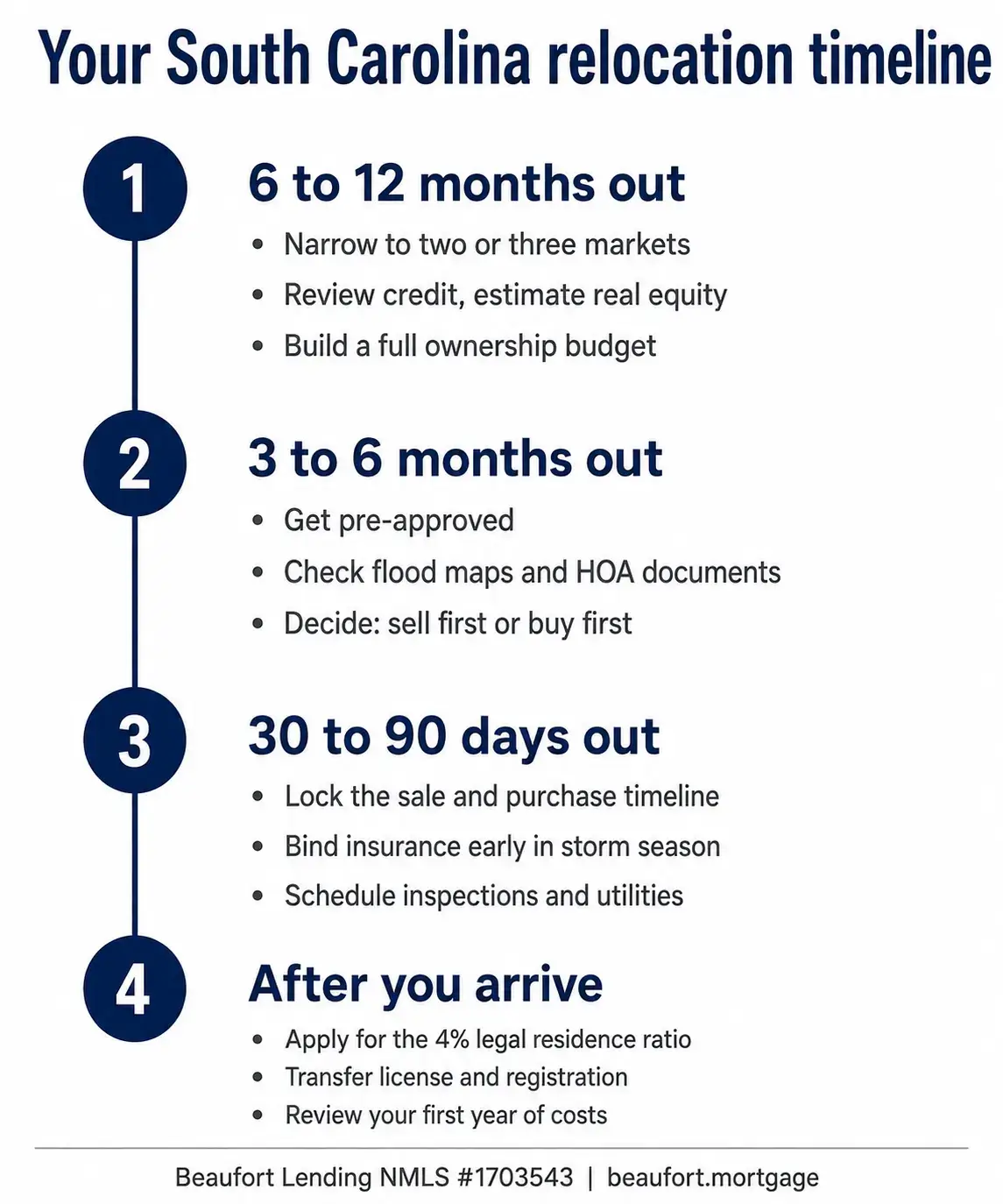
Six to twelve months before the move
- Narrow to two or three markets using total ownership cost, not sticker price.
- Pull your credit reports and address anything that will take months to fix.
- Estimate your realistic net equity after commissions, repairs, and payoff, not your Zestimate.
- Confirm in writing whether your employer permits you to work remotely from South Carolina, or start the job search here.
- Build a full ownership budget for each candidate market: principal and interest, property taxes at the 4% ratio, homeowners insurance, wind coverage if coastal, flood if applicable, HOA or regime dues, and utilities.
- Have an early financing conversation to find out which of those markets your budget actually reaches.
Three to six months out
- Get a full pre-approval based on current documentation.
- Interview local real estate agents in your top market. Local is not a formality here: flood zones and HOA rules change street to street.
- Ask an insurance agent what is actually available in your target neighborhood before you assume a premium.
- Look up candidate addresses on FEMA's Flood Map Service Center.
- Request HOA or regime documents: budget, reserves, dues history, rules, pending assessments.
- Decide your sell-first, buy-first, or coordinated-closing strategy, and price the fallback if timing slips.
Thirty to ninety days out
- Lock the sale and purchase timeline, and confirm what happens if either side moves.
- Assemble employment documentation: offer letter, contract, remote-work confirmation, recent pay stubs.
- Get real insurance quotes on the specific property, and bind coverage as early as your contract allows during hurricane season.
- Schedule inspections: general, plus wind mitigation, termite or CL-100, and any specialty inspection the property warrants.
- Arrange utilities, movers, school records, medical records, and mail forwarding.
- Set aside reserves for first-year repairs and transition costs on top of your closing funds.
After you arrive
- Apply with your county assessor for the 4% legal residence assessment ratio. The application generally must be filed before the first penalty date for taxes due, January 16, and counties may publish earlier practical deadlines. Approving it also triggers the school operating millage exemption, which requires no separate application.
- Transfer your driver's license and register your vehicles with the SCDMV, and note you must pay county vehicle property tax to the county treasurer before you can register.
- Register to vote, update your address with the IRS and your financial institutions, and stop claiming any residence-based tax benefit in your former state.
- Review your first full year of ownership costs against the budget you built, and adjust escrow if the estimate was off.
Frequently asked questions about moving to South Carolina
Is it expensive to live in South Carolina?
Compared with the national average, no. South Carolina's 2024 regional price parity was 93.7, meaning overall price levels ran about 6% below the U.S. average, per the Bureau of Economic Analysis. Compared with New Jersey (108.8) or New York (107.9), the gap is wider still. But the savings are not uniform. Housing and property taxes are where most of the difference shows up. Homeowners insurance is moving the other way, especially within a few miles of the coast, and Pennsylvania households often find the overall gap much smaller than they expected.
What is the best place to live in South Carolina?
There is no single best market, only a best fit. Greenville and Columbia are the inland value markets with the lowest total ownership costs and the least weather-driven insurance exposure. Charleston offers the strongest urban job market at a higher price. Beaufort and Hilton Head Island suit buyers who want the Lowcountry and are willing to budget for coastal insurance and, on the island, HOA and regime fees. Myrtle Beach has the lowest entry price of the coastal markets, particularly for condos, which carry their own financing and fee considerations.
Can I buy a house in South Carolina before I move?
Yes. Nothing requires you to live in South Carolina before you buy here. What matters to a lender is how you intend to occupy the home. A primary residence you will move into carries different terms than a second home or a rental, and you sign an occupancy statement at closing. If you plan to occupy the home as your legal residence but will not move in immediately, say so early, because it affects both the loan terms and the property tax ratio the county applies.
Can I qualify using income from a new South Carolina job?
Often yes, but the documentation matters more than the salary. Underwriting generally wants an executed offer letter or employment contract with the start date, pay, and terms, and it looks at how soon the job begins relative to closing. Guidelines vary by loan program and by lender, and some scenarios require the first pay stub before funding. If you are relocating on a job offer, have that offer reviewed before you write an offer on a house.
Are South Carolina property taxes lower than Northeast property taxes?
For an owner-occupied primary residence, generally yes, and the gap is large. Median property taxes paid were $2,174 in Beaufort County and $1,901 in Charleston County, against $10,000 or more in Bergen County, New Jersey and Nassau County, New York, per Tax Foundation's 2026 county report using 2024 Census five-year data. Two cautions: those medians reflect owner-occupied homes receiving South Carolina's 4% ratio and school operating exemption, and your own bill is set by what you paid for the home, not by the county median.
How much money should I save before moving to South Carolina?
Plan for four buckets: the down payment, closing costs, the move itself, and post-closing reserves. The bucket people underestimate is the last one. First-year surprises in this state tend to be insurance premiums paid up front at closing, county vehicle property tax owed before you can register a car, and repairs that inspection turned up but you deferred. A practical target is enough reserve to cover several months of the new housing payment after everything else is paid.

Next steps and useful resources
If you have narrowed it to a market or two and want to know what the payment really looks like there, including taxes at the right assessment ratio and a realistic insurance figure, that is a short conversation, and it does not require you to be ready to buy.
We can help with a relocation financing review, a payment estimate for a specific address, a pre-approval when you are close enough to write offers, and coordinating the financial timing between selling up north and closing here.
Planning a Move to South Carolina? Let's Run Your Numbers
Get a custom rate quote in minutes, calculate your payments, or just reach out with questions.
- Estimate a payment with our mortgage calculator
- Submit your relocation scenario
- Call Us: 843-524-2404
- Chat With Our Team (Opens in Messenger)
Other resources you may find helpful
- South Carolina financing paths, organized by what you are trying to do
- Selling up north and buying here: how to use your equity without the stress
- Retiring here and want to buy before you sell?
- Financing options in Beaufort
- Financing options in Charleston
- Financing options in Columbia
- Financing options in Greenville
- Financing options on Hilton Head Island
- Financing options in Myrtle Beach

Benji Gecy, NMLS #302188. Beaufort Lending, NMLS #1703543. Beaufort Lending is an Equal Housing Opportunity Lender. All loan programs, rates, and terms are subject to change without notice and are based on individual qualifications. This content is for informational purposes only and is not a commitment to lend, and it is not tax, legal, or insurance advice. Consult a qualified professional about your situation. Borrowers must meet specific underwriting requirements. Rates, terms, and program availability vary by borrower, loan type, property, and market conditions. Market, tax, and insurance figures cited are current as of the dates shown and change over time.