

FHA vs Conventional in South Carolina: Which One Actually Saves You More Money?
By Benji Gecy, NMLS #302188 | Beaufort Lending | Updated June 2026
For most South Carolina buyers, FHA vs conventional comes down to two things: your credit score and how long you plan to keep the loan. Borrowers under 680 usually do better with FHA. Borrowers at 720 and above usually come out ahead with conventional because private mortgage insurance cancels automatically at 20% equity, while FHA mortgage insurance runs for the life of the loan.
Every week somebody asks us some version of this question. And honestly, it's one of the best questions you can ask before you start shopping for a home, because the answer can mean the difference between paying $10,000 more in mortgage insurance over the next several years or not.
So let me give you a real breakdown. Not the generic "it depends" answer you'll get from a lot of sites. Actual numbers, actual scenarios, and a plain explanation of why this decision matters more than most buyers realize.
What is the actual difference between FHA and conventional in South Carolina?
FHA loans are government-backed and allow credit scores as low as 580 with 3.5% down, but require mortgage insurance for the life of the loan. Conventional loans require at least a 620 credit score, have stricter debt-to-income guidelines, but charge private mortgage insurance only until you reach 20% equity, then it stops automatically.
Both loan types are available on South Carolina home purchases up to the 2026 conforming loan limit of $832,750, which applies to every county in the state. So for most SC buyers purchasing near the statewide median home price of around $300,000 to $360,000, the limit itself is not a factor. The decision is almost entirely about credit score, mortgage insurance, and how long you stay in the home.
The biggest misconception I hear constantly is that you need 20% down for conventional. You don't. You can put 3% to 5% down on a conventional loan. The 20% threshold matters for a different reason: it's the point where mortgage insurance stops. That's what makes conventional cheaper over time for the right borrower.
Quick side-by-side at a glance
- 580+ credit score for 3.5% down
- 500-579 with 10% down
- More flexible on debt-to-income ratio
- MIP lasts life of loan (with less than 10% down)
- MIP rate same regardless of credit score
- No loan-level price adjustments
- 620+ credit score minimum
- 3% to 5% down options available
- Stricter debt-to-income guidelines
- PMI cancels automatically at 20% equity
- PMI rate varies by credit score
- Loan-level price adjustments apply
How does mortgage insurance work differently and why does it matter so much?
FHA mortgage insurance costs about $137 per month on a $300,000 loan and does not cancel if you put less than 10% down. Conventional PMI on the same loan cancels automatically once you hit 20% equity, which most South Carolina homeowners reach in 3 to 7 years at current appreciation rates.
This is the whole ballgame when it comes to long-term cost. FHA has two pieces of mortgage insurance: an upfront premium of 1.75% of the loan amount, which gets rolled into the loan at closing, and an annual premium of 0.55% paid monthly. On a $300,000 purchase with 3.5% down, that annual MIP works out to about $137.50 per month. And if you put less than 10% down, it runs for the entire 30-year loan term. That's a real cost of FHA financing in South Carolina that a lot of buyers don't fully account for upfront.
Conventional PMI works differently. The rate varies based on your credit score and how much you put down, typically running between 0.46% and 1.50% of the original loan amount per year. On that same $300,000 loan at a good credit score, you might pay $90 to $110 per month. But here's what matters: per federal law, conventional PMI must be cancelled automatically when your loan balance drops to 78% of the original home value. You can request cancellation at 80%. At SC appreciation rates of 3% to 5% per year, most buyers hit that mark in 3 to 7 years.
Here's a number worth sitting with. On a $300,000 FHA loan with 3.5% down, total MIP over 30 years adds up to roughly $49,500 in mortgage insurance. On a conventional loan with a solid credit score, PMI might total $10,000 to $15,000 before it cancels. That gap is real money, and it's the main reason conventional beats FHA over the long run for the right borrower.
The flip side is this: FHA MIP is the same rate no matter what your credit score is. Conventional PMI is not. If your score is in the 580 to 640 range, your PMI rate on a conventional loan goes up significantly. So for lower-credit borrowers, FHA's flat MIP rate is actually a better deal even before you factor in the rate itself.
What credit score determines which loan actually saves you more?
Below 620, FHA almost always wins because conventional loans become significantly more expensive through risk-based pricing adjustments. At 720 and above, conventional usually wins by a wide margin over the life of the loan. The 620 to 719 range is where running both scenarios side by side matters most.
There's something most people don't know about conventional loans called loan-level price adjustments, or LLPAs. These are risk-based fees that Fannie Mae and Freddie Mac apply to conventional mortgages based on credit score, down payment, and other factors. They get built into your interest rate, so you don't see them as a separate line item. But they're real, and they can make conventional loans significantly more expensive for borrowers with lower scores.
The important thing to know: LLPAs don't apply to FHA, VA, or USDA loans. So a borrower with a 620 credit score is comparing a conventional loan with a meaningful LLPA surcharge against an FHA loan with no LLPA surcharge. That changes the math.
Here's how to think about the four credit score ranges:
Under 620: FHA almost always wins. Conventional is barely available and the rate will be noticeably higher because of LLPA stacking. FHA's more flexible guidelines and flat MIP rate make it the clear path.
620 to 679: FHA is usually the better call. You can get conventional approval in this range, but LLPAs add meaningful cost and your PMI rate will be on the higher end of the range. Run both scenarios, but FHA tends to win for buyers at this credit level who aren't putting significant money down.
680 to 719: This is the competitive zone where it genuinely depends on your down payment, your debt-to-income ratio, and how long you plan to stay in the home. A borrower at 700 with 5% down and a 5-year horizon might actually come out ahead with conventional once you factor in PMI cancellation. Call us and we'll run both.
720 and above: Conventional usually wins. Lower rate, lower PMI cost, and PMI cancels in a few years. The long-term savings over FHA's life-of-loan MIP are typically $15,000 to $40,000 depending on loan size and how long you hold the loan.
What does the math actually look like on a South Carolina home purchase?
On a $300,000 South Carolina home with 3.5% down, FHA costs about $137 per month in mortgage insurance that never cancels. A conventional loan with a 720+ credit score carries lower PMI that cancels in roughly 4 to 6 years, saving most buyers $30,000 to $40,000 over the life of the loan. For borrowers under 640, FHA is often the cheaper option on a monthly basis.
Here's a side-by-side look using a $300,000 purchase price. These are illustrative examples to show how the structure of each loan type works. Your actual numbers will depend on your credit score, lender, market conditions, and down payment.
| Scenario | FHA (580-620 score) | Conventional (640-679 score) | Conventional (720+ score) |
|---|---|---|---|
| Purchase price | $300,000 | $300,000 | $300,000 |
| Down payment | 3.5% / $10,500 | 5% / $15,000 | 5% / $15,000 |
| Loan amount | ~$294,788 (MIP rolled in) | $285,000 | $285,000 |
| Monthly MIP / PMI | ~$137/mo (0.55%) | ~$150-185/mo (0.65-0.80%) | ~$85-110/mo (0.40-0.50%) |
| Insurance cancels? | No. Life of loan. | Yes. At 20% equity. | Yes. At 20% equity. |
| Est. years to cancel | Never (unless refinance) | ~5-8 years | ~4-6 years |
| Est. total insurance cost | ~$49,500 over 30 years | ~$12,000-$15,000 | ~$8,000-$11,000 |
| Best fit | Lower credit, higher DTI, or limited down payment | Moderate credit, can't wait to improve score | Strong credit, wants lower long-term cost |
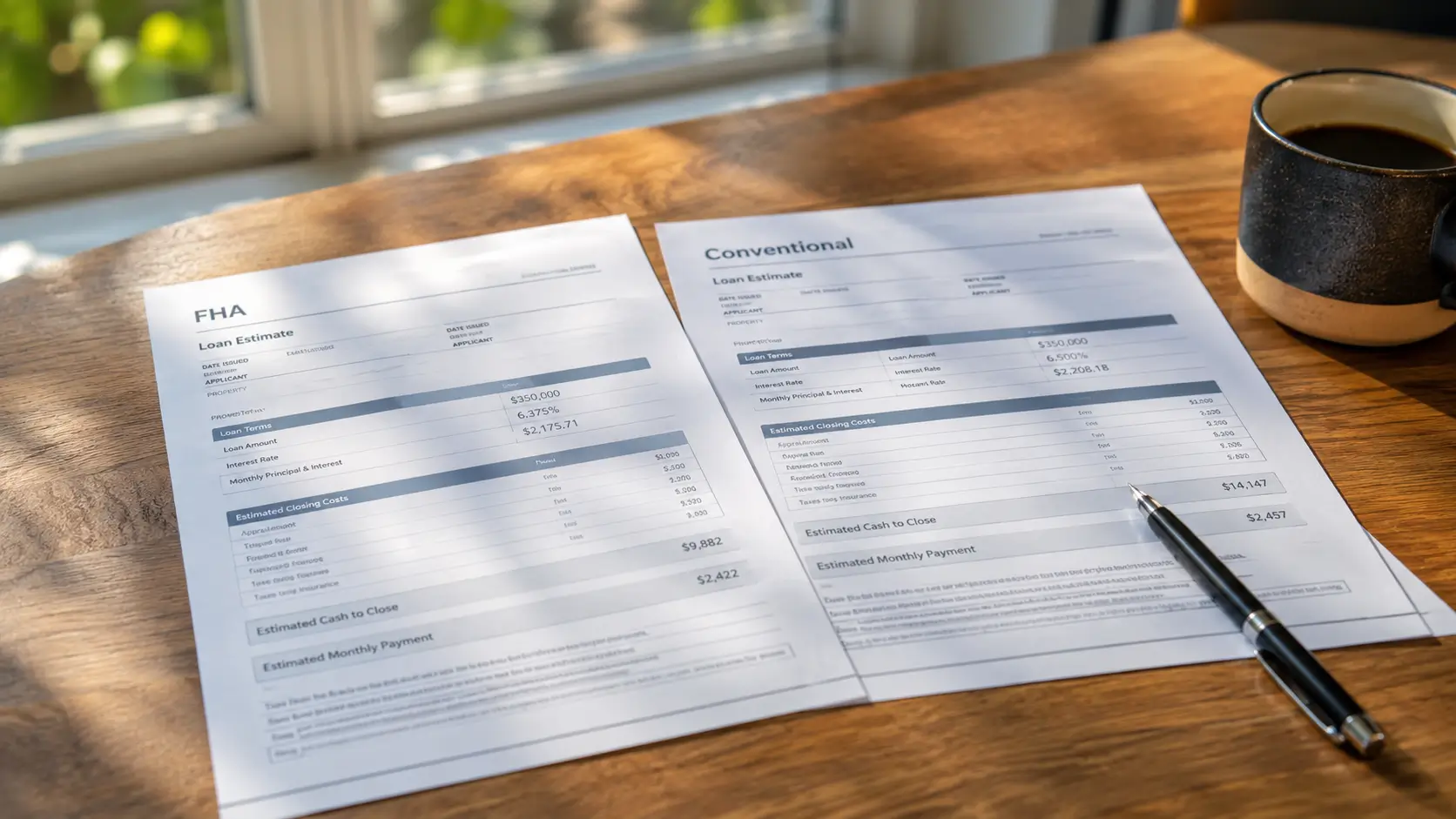
These figures are illustrative only. Actual rates, PMI costs, MIP rates, and loan terms vary based on borrower credit profile, lender, down payment, property type, loan program, and market conditions. Rate assumptions based on June 2026 market environment. Contact Beaufort Lending for a custom side-by-side comparison on your specific file.
One thing that table doesn't capture is the monthly payment difference at the rate level. Conventional loans carry risk-based rate adjustments for lower credit scores that FHA doesn't have. So for a borrower at 600, the conventional rate itself will be higher than the FHA rate, not just the PMI. That's another reason FHA often wins on total monthly payment for that borrower, even if it loses on lifetime mortgage insurance cost.
Are there South Carolina-specific factors that affect this decision?
South Carolina's affordable home prices mean most buyers stay well under both loan limits, so the FHA vs conventional choice is almost entirely about credit score and mortgage insurance rather than loan size. The exception is coastal SC, where prices in Charleston and Beaufort push buyers closer to the FHA county limits.
Most South Carolina counties follow the standard national FHA loan limits for 2026. Here's how the limits break down across the state:
- FHA Most SC counties: $541,287 floor for a single-family home
- FHA Charleston, Berkeley, Dorchester: $690,000
- FHA Beaufort County (Hilton Head area): $638,250
- CONV All SC counties: $832,750 conforming limit statewide — no high-cost counties in SC
What that means practically: if you're buying at the SC median home price of around $300,000 to $360,000, you've got plenty of headroom under both limits. The limit isn't the deciding factor. Credit score and mortgage insurance math is.
A few other SC-specific things worth knowing:
- Property taxes are low. South Carolina's effective property tax rate is around 0.51%, one of the lowest in the country. That keeps your total monthly payment lower than in many other states regardless of which loan type you choose.
- SC Housing's Palmetto Home Advantage program Available with both FHA and conventional across all 46 SC counties, with forgivable down payment assistance and income limits up to $135,750. All loan options require a 640 minimum credit score. If you're at 580 to 639, you'd need a standard FHA loan rather than the state program.
- Military buyers near Parris Island should look at VA first. If you're eligible for a VA loan, it usually beats both FHA and conventional. Zero down payment, no mortgage insurance, no PMI, no MIP. For eligible borrowers, the VA loan is almost always the right call.
- Coastal SC buyers in the $500K-$600K range Pay attention to the FHA county limits. At $638,250 for Beaufort and $690,000 for Charleston, FHA can still work in those markets, but conventional may give you more flexibility on loan structure at higher price points.
Should I do FHA or conventional? Here's how I think about it.
The answer is almost never the same for two buyers. It depends on your credit score, how much you have to put down, your debt levels, and how long you plan to stay in the home. Running both scenarios side by side on your actual file is the only way to know for sure.
"Listen, it depends on your situation. There are a couple of differences that'll help us figure out which one makes sense for you."
"If you've got a higher credit score and can put down more money, conventional is probably going to save you money. The big reason is the mortgage insurance. With conventional, PMI drops off automatically once you hit 20% equity. You don't have to refinance out of it. That's real money right there."
"But if your credit isn't great, or you've got higher debt levels, FHA is probably going to be your best bet because it'll get you in the door. FHA is more forgiving on both of those things."
"Here's the honest answer: conventional loans are cheaper over the life of the loan because you can cancel the mortgage insurance without refinancing. But FHA gives you faster access to homeownership when your situation doesn't line up perfectly for conventional. So it really just depends on where you're at."
"Call us. We'll pull up both options on your actual numbers and show you exactly what each one looks like. That's the only way to really know."
Can I start with FHA and switch to conventional later?
Yes, and for many South Carolina buyers this is actually the smart play. Use FHA to get into a home now, build equity through payments and appreciation, then refinance into a conventional loan once you hit 20% equity to eliminate the MIP entirely.
This strategy works well in South Carolina's current market. Home values in most SC markets have appreciated steadily, which means the equity gap between purchase price and 20% equity closes faster than most buyers expect. At 3% to 5% annual appreciation on a $300,000 home, you're looking at reaching 20% equity in roughly 4 to 7 years through a combination of principal paydown and value increase.
When you refinance from FHA to conventional at that point, two things happen: the MIP disappears, and if your credit has improved during that period, you may qualify for a better rate than you would have gotten on the original loan. A lot of borrowers who started with FHA at a 600 credit score are refinancing at 680 or 700 three to five years later. That's a meaningful improvement in both rate and insurance cost.
Two things to keep in mind. First, refinancing isn't free. You'll pay closing costs again, typically 2% to 3% of the loan amount, which needs to pencil out against your monthly savings. We'll run a breakeven analysis before you pull the trigger. Second, you'll need to qualify for conventional at refinance time. That means your income, credit, and debt levels all need to meet conventional guidelines at that point.
If you're buying with FHA now because your credit or debt situation doesn't qualify for conventional, build a plan for the refinance exit from day one. Pay on time, pay down revolving debt, and let the home appreciate. We've helped a lot of SC borrowers map out exactly that path.
Common questions about FHA vs conventional in South Carolina
Is FHA or conventional better for South Carolina buyers?
For most SC buyers, FHA is better when your credit score is below 680 or your debt-to-income ratio is on the higher side. Conventional is usually better at 720 and above because PMI cancels automatically while FHA mortgage insurance runs for the life of the loan.
What credit score do I need for a conventional loan in South Carolina?
Most lenders require a minimum 620 for conventional. But a 620 score means higher loan-level price adjustment fees that raise your rate. Scores of 720 and above unlock the best conventional pricing and the lowest PMI rates.
Can I switch from FHA to conventional later?
Yes. Many SC buyers use FHA to get in, build equity, then refinance into conventional once they hit 20% equity to eliminate MIP. At typical SC appreciation rates, most borrowers reach that point in 4 to 7 years.
Does FHA or conventional have higher loan limits in South Carolina?
Conventional has the higher limit at $832,750 statewide. FHA limits range from $541,287 in most counties to $690,000 in the Charleston tri-county area. For most SC buyers near the median price, neither limit is a barrier.
Not sure which one is right for you? Let's run both.
Call or text Beaufort Lending and we'll pull up FHA and conventional side by side on your actual credit score, purchase price, and down payment. Takes about 10 minutes. Saves you potentially thousands over the life of the loan.
Beaufort Lending LLC, NMLS #1703543. Benji Gecy, NMLS #302188. All loan examples are illustrative. Rates, costs, and program availability vary by borrower qualification, property, lender, and market conditions. Not a commitment to lend.