By Benji Gecy, NMLS #302188 | Beaufort Lending, NMLS #1703543 | Originally published May 2025 | Last updated: August 2026
A Second Home in the Upstate Finances Differently Than the Home You Live In
The short answer: financing a second home near Greenville works differently than financing the home you live in. You will need at least 10% down, you will need cash reserves covering both mortgages, and South Carolina will tax the property at 6% of value instead of 4%. Rates on second homes also run above primary residence rates. None of that makes a lake house a bad idea. It just means the numbers need running before you fall in love with a dock.
Here is the part that trips people up. If you have been told a second home finances "just like a primary residence," that advice is out of date. It has not been true for years, and the reason is worth understanding before you shop.
What this guide covers
Written for buyers looking at Lake Keowee, Lake Hartwell, the Blue Ridge foothills, and downtown Greenville. Jump to what you need.
- What actually counts as a second home, including the distance rule almost everyone gets wrong
- Why second home rates run higher, and what actually moves yours
- Second home or investment property? The old gap between them has closed
- Where Upstate buyers actually buy, and why the county matters
- Your four financing paths
- Buying as a retiree
- The South Carolina tax rule that surprises out-of-state buyers
- Twelve questions buyers ask us most
What Actually Counts as a Second Home
This is the most important classification in the whole transaction. Get it wrong on purpose and it is occupancy fraud. Fannie Mae's Selling Guide sets out six requirements, and they are more specific than most buyers expect.
Fannie Mae's six second home requirements
- Occupied by you for some portion of the year
- Restricted to one-unit dwellings
- Suitable for year-round occupancy, which rules out seasonal-only cabins
- You must have exclusive control over the property
- Not a rental property or timeshare arrangement
- No management firm agreement that controls occupancy
You will see this figure repeated constantly online, stated as though it were a rule.
There is no mileage requirement in the Selling Guide, as you can confirm for yourself in the six requirements above. What matters is that the property genuinely functions as a second home rather than a duplicate of the one you already live in. Individual lenders may layer on their own distance overlays, so the question worth asking is not "how far is far enough" but "does this specific lender apply an overlay." A Greenville resident buying at Lake Keowee, about 45 minutes away, is a routine second home file.
Occasional short-term rental generally does not disqualify a second home. Running it as a full-time rental business does, and at that point the loan becomes an investment property loan.
Be careful how you describe your plans. Telling a lender you intend to occupy a property personally while planning to rent it full time is mortgage occupancy fraud, and it is a federal offense. If your real intent is rental income, say so. There are good products built for exactly that, and the next section explains why the old pricing incentive to fudge this has completely disappeared.
Why Second Home Rates Run Higher Than Primary Residence Rates
Mortgage pricing is built on risk, and the single best predictor of whether a loan gets repaid is whether the borrower lives in the house.
When money gets tight, people protect the roof over their heads first. A primary residence is the last payment a borrower walks away from. A vacation house at the lake, however much they love it, sits further down the list, and an investment property sits further down still. Lenders and the agencies behind them price for that difference.
Primary residences earn the best rates available because they carry the lowest default risk. Second homes price above them. Investment properties price above that. It is not a penalty for buying a lake house, it is the same risk-based logic that gives a stronger credit profile a better rate than a weaker one.
Two things follow from this that are worth knowing before you shop.
Your down payment moves your rate more than it does on a primary residence. The more equity you put in, the less risk the lender carries, and second home pricing rewards that more steeply. Buyers who can reach 20% down, or better, tend to see a meaningfully different quote than buyers at the 10% minimum. If you are close to one of those thresholds, it is worth a conversation before you decide how much to put down.
Condominiums and unique properties carry their own pricing considerations on top of occupancy, which matters for downtown Greenville buyers in particular.
How much can you borrow?
Fannie Mae caps a second home purchase at 90% loan-to-value, so 10% down is the conforming floor. There is no 5% down or 3% down second home option in the conforming world, and no zero-down conforming path at all. A cash-out refinance on a second home is capped tighter, at 75%.
Above 80% loan-to-value you also carry mortgage insurance until the combined loan-to-value drops back to 80%. That is a separate monthly cost on top of the rate difference, and it is a large part of why most second home buyers end up putting 20% or more down once they see their options side by side.
Second Home or Investment Property? The Old Pricing Gap Has Closed
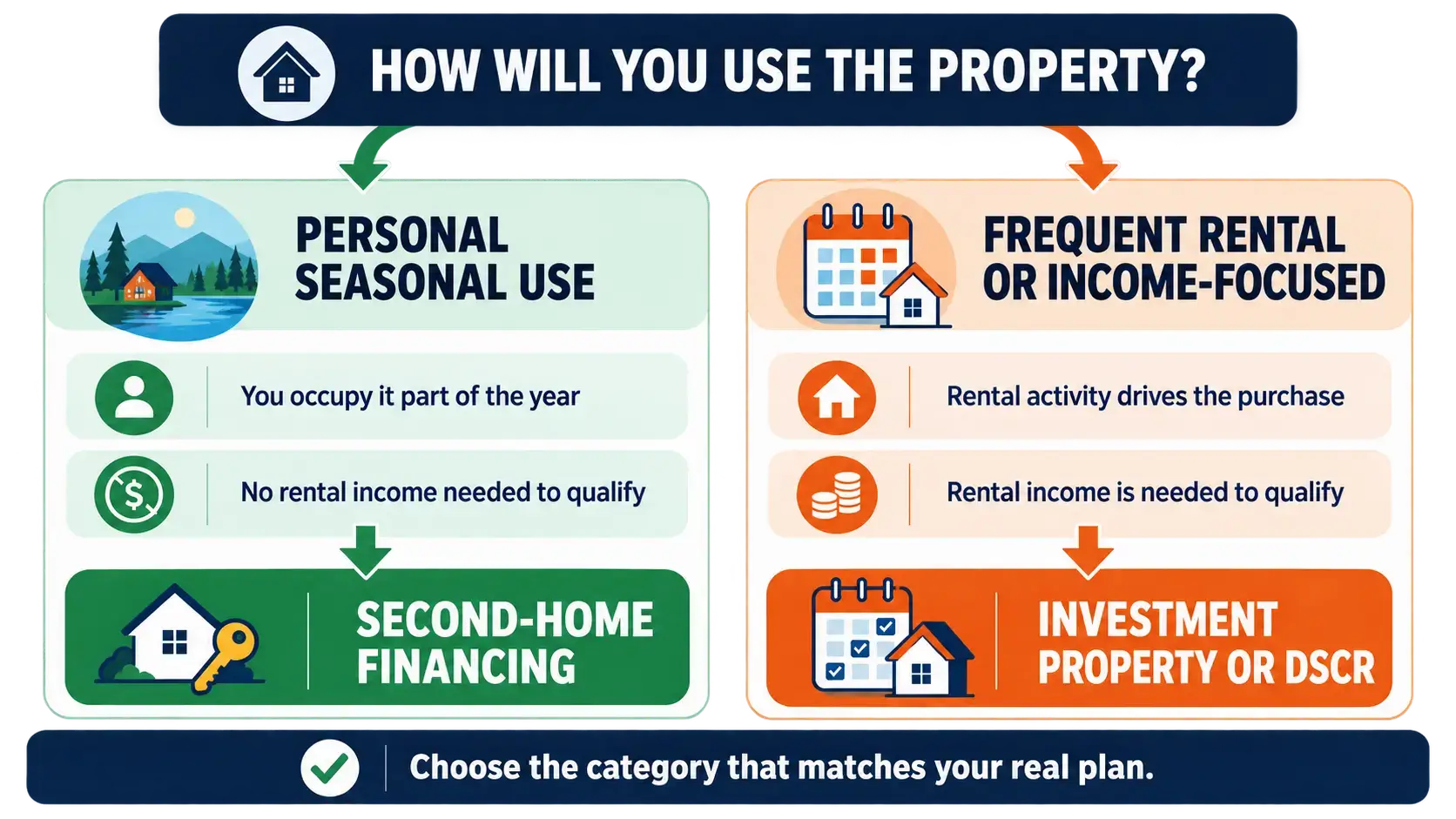
For years the standard advice was that a second home finances more cheaply than an investment property, so buyers stretched the definition of personal use to land in the better category. That advantage has since disappeared.
Under current agency pricing, second homes and investment properties are treated the same way on occupancy. The thing people used to fudge the paperwork for no longer buys them anything.
Primary residence
- Rate tier
- Best available
- Minimum down
- As little as 3%
- Rental income to qualify
- No
- SC tax assessment
- 4%
Second home
- Rate tier
- Above primary
- Minimum down
- 10%
- Rental income to qualify
- No
- SC tax assessment
- 6%
Investment property
- Rate tier
- Highest of the three
- Minimum down
- Higher than 10%
- Rental income to qualify
- Yes
- SC tax assessment
- 6%
Read the middle and right columns together. Occupancy pricing and tax treatment are now the same. What still separates them is how much you can borrow, and one thing that matters more than everything else combined.
On an investment property loan, the property's rental income can help you qualify. On a second home loan it cannot, which means the entire payment must fit inside your personal debt-to-income ratio alongside your existing mortgage. For most buyers that is the constraint that determines which product is even possible.
Where Upstate Second Home Buyers Actually Buy
Greenville is the hub, but most Upstate second home purchases do not happen inside Greenville County. That matters more than buyers expect, because tax districts, millage rates, and flood considerations are all set at the county level.
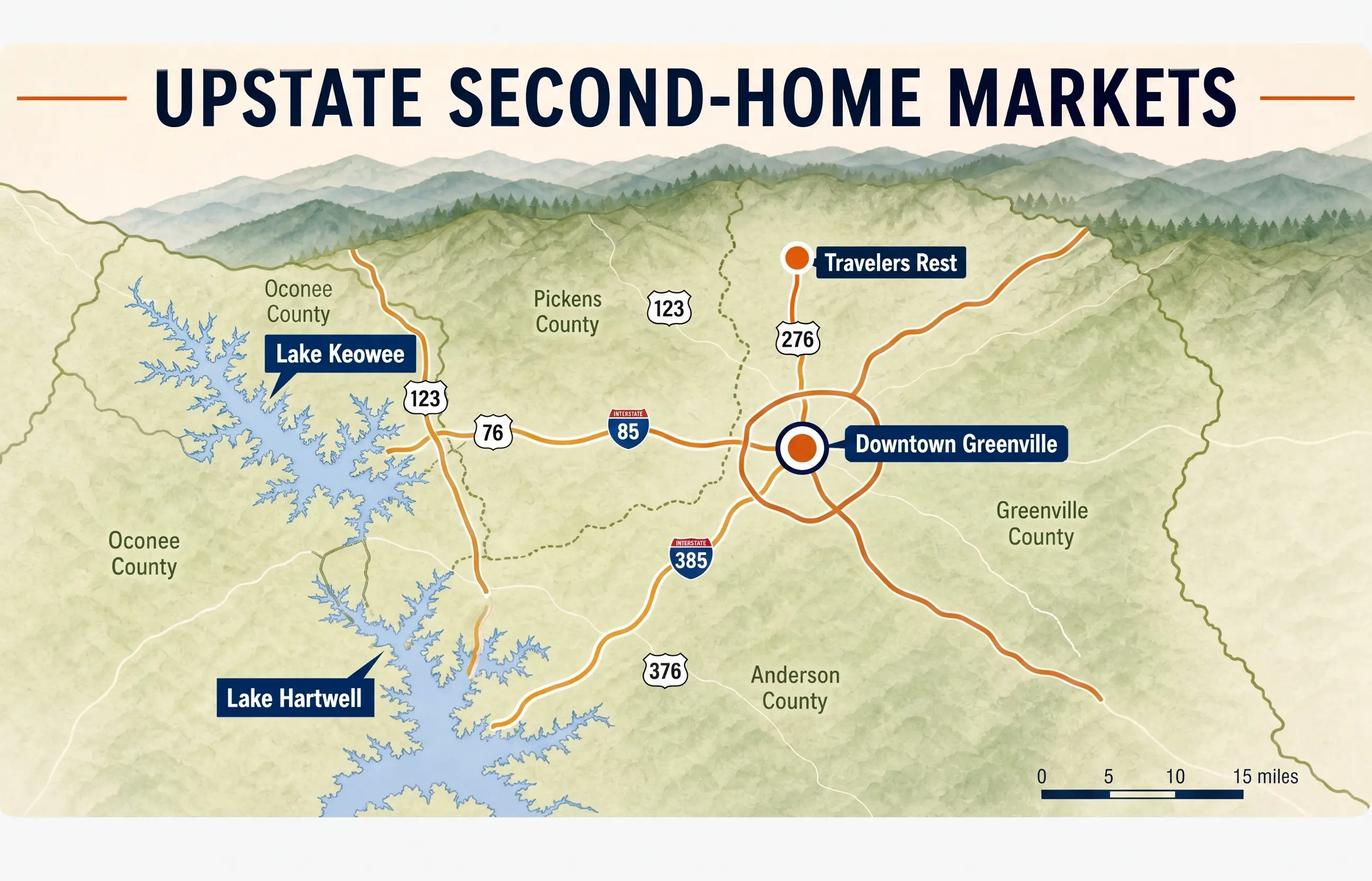
Lake Keowee
Oconee CountyPickens CountyUsually jumboThe premier Upstate second home market and the one that most often pushes buyers past the conforming limit. About 45 minutes from downtown Greenville. Waterfront and Cliffs communities routinely list well above $832,750, so assume jumbo until proven otherwise.
Lake Hartwell
Anderson CountyOconee CountyPickens CountyLarger and generally more affordable than Keowee, with a wider mix of price points and plenty of inventory that stays comfortably inside conforming limits. Where buyers who want water access without a jumbo loan tend to land.
Blue Ridge foothills and Travelers Rest
Greenville CountyTravelers Rest has become a genuine second home market in its own right, driven by the Swamp Rabbit Trail and mountain access. Cabins and small acreage north toward Caesars Head draw buyers who want elevation rather than water. Watch the year-round occupancy requirement on seasonal cabins.
Downtown Greenville condos
Greenville CountyExtra reviewA walkable base near Main Street and Falls Park. Financially the trickiest of the four: condo financing carries pricing considerations on top of occupancy, and the project gets underwritten before you do. Owner-occupancy ratios, HOA reserves, insurance, and litigation all get reviewed.
Greenville market context. According to the Greater Greenville Association of REALTORS Monthly Indicators report for July 2026, current as of August 10, 2026, the association-wide median sale price was $326,000, down 1.7% year over year. Days on market rose 10.4% to 53 days, inventory grew 9.3% to 6,448 units, and months supply reached 4.2. Note that this covers the entire association territory and runs well below waterfront pricing at Keowee. Buyers do have more negotiating room than they did a year ago.
Your Four Financing Paths
Most Upstate second home purchases route through one of four products. Which one fits depends on the price point, how you document income, and how much rental activity you actually intend.
Conventional second home
The default path and the right one for most buyers under the conforming limit. Ten percent down minimum, with standard fixed and adjustable structures available.
Best for: documentable W-2 or established self-employment income, with genuine personal use.
Jumbo
Cross the conforming limit and you are in jumbo territory, common on Keowee waterfront and in Cliffs communities. Programs are investor-specific rather than governed by one rulebook, so down payment, reserve, and credit requirements vary.
Best for: higher-value properties. See our South Carolina jumbo loan guide.
DSCR
If the property will spend most of the year generating rental income, this is the correct product and the correct disclosure. Qualification runs off the property's rental income, with no personal debt-to-income calculation.
Best for: income-first purchases. See our Greenville DSCR loan page.
Bank statement
Greenville's economy produces many business owners whose tax returns understate what they actually earn, exactly the profile that struggles with conventional qualification. Qualify on 12 to 24 months of deposits instead.
Best for: business owners and contractors. See our bank statement program.
On the conforming limit itself: the 2026 baseline is $832,750 for a one-unit property in every South Carolina county, up $26,250 from 2025, per the Federal Housing Finance Agency. It is worth checking a target property against that number early, because it determines which of these four products you are even applying for.
Not sure which of the four paths fits your situation?
Send us the property you have in mind, the price range, your down payment, and how you document income. Beaufort Lending will tell you which of these four products your file actually fits and what each one would cost you, rather than pointing you at a program name and leaving you to work it out.
Submit Your ScenarioBuying a Second Home as a Retiree
A large share of Upstate second home demand comes from buyers in their late fifties and sixties, often from the Northeast or Midwest, who are buying now with the intention of retiring here later. That plan has specific financing consequences worth understanding before you shop.
Retirement income documents differently
Social Security, pension, and annuity payments are all usable qualifying income, but they need award letters and continuation evidence rather than pay stubs. Retirement account distributions work too, provided the account shows enough remaining balance to support continued withdrawals.
Asset depletion can bridge the gap
If you are asset-rich and income-light, which describes many pre-retirement buyers, certain programs convert a qualifying asset balance into a monthly income figure. This is often the difference between qualifying and not for buyers who have done everything right but no longer draw a salary.
Buying before you retire is easier
Qualifying while you still have employment income is materially simpler than qualifying after it stops. If an Upstate second home is part of your retirement plan, the financing conversation is worth having earlier than most people have it.
The conversion question matters for taxes
If you intend to make the property your legal residence later, the 4% assessment ratio is worth real money. The rules for claiming it carry specific occupancy and rental limits, covered in the next section.
What Lenders and the Tax Assessor Check Beyond the Rate
Reserves for two mortgages
You are about to carry two housing payments. Lenders require cash reserves covering both, and those reserves must remain after your down payment and closing costs are paid, not come out of them. The specific requirement varies by product, credit profile, and property type, with condominiums generally requiring more. This is the single most common reason a second home pre-approval comes back smaller than the buyer expected.
Insurance runs higher
Second home policies typically cost more than primary residence coverage, because the property sits unoccupied for stretches of the year. Waterfront properties at Keowee and Hartwell add dock and shoreline coverage considerations. Greenville County itself is predominantly inland with very few properties in FEMA flood zones, but lake properties in Oconee, Pickens, and Anderson counties need their flood status verified individually rather than assumed.
The South Carolina 4% versus 6% rule, and the part most buyers miss
This is the item that surprises out-of-state buyers most often, and most coverage of it stops halfway. Here is the whole picture.
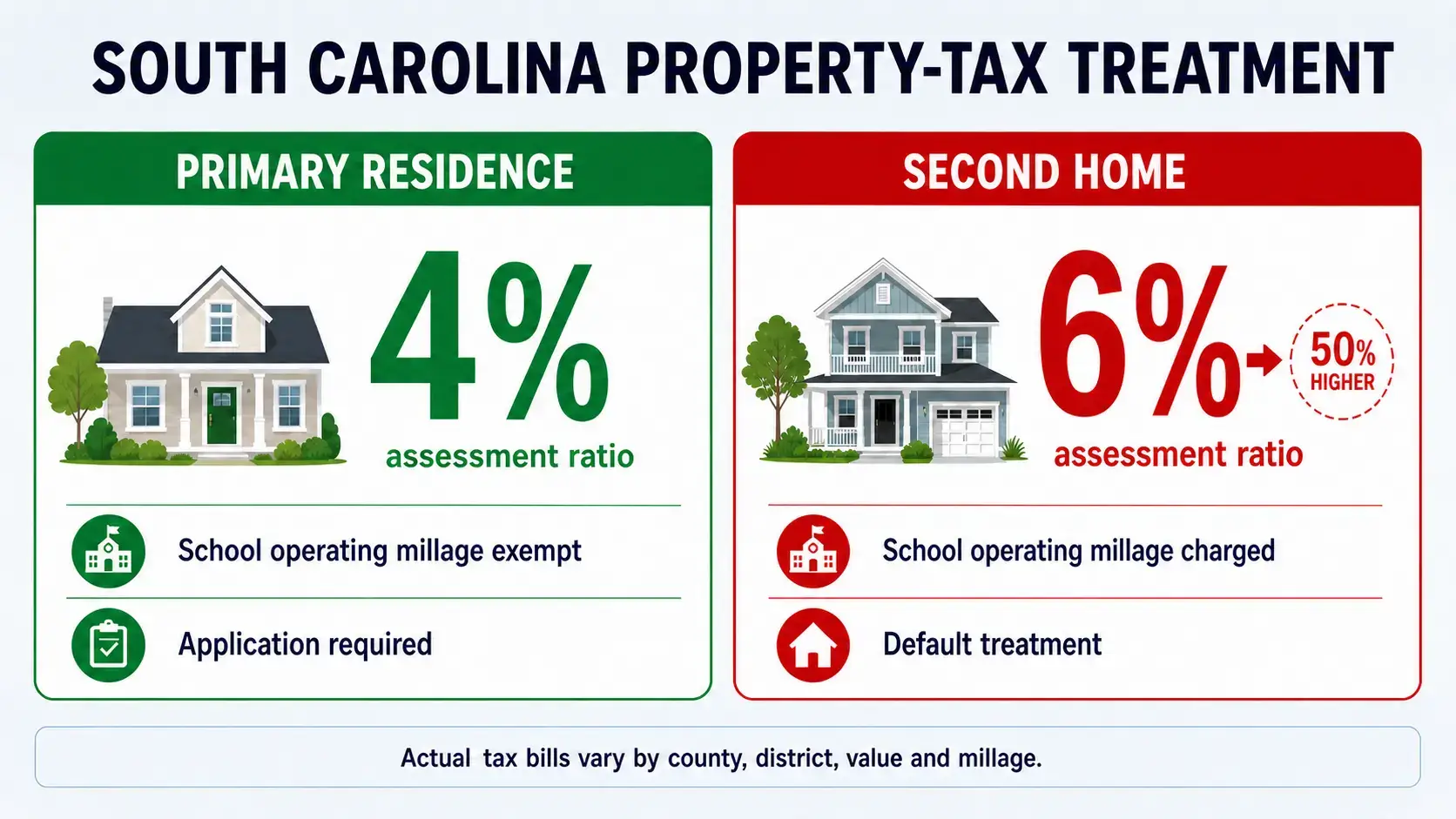
Your primary residence
- Assessed at 4% of fair market value
- Exempt from all school operating millage
- Must apply with the county assessor
Your second home
- Assessed at 6%, a 50% higher taxable value
- Pays school operating millage in full
- No application, it is the default
The assessment ratio is the half everyone knows. The exemption is the half that costs more.
Under S.C. Code Ann. Section 12-37-220(B)(47), a residence qualified as a 4% legal residence is exempt from all property taxes imposed for school operating purposes. That exemption does not extend to 6% properties. School operating millage is normally the largest single component of a South Carolina property tax bill.
A second home pays both a 50% higher assessment ratio and an entire tax line that primary residences skip. Those two effects compound, which is why owners in local forums routinely report second home bills running roughly double what a full-time resident pays on a comparable house.
Millage varies by district, and Greenville County alone contains well over a hundred tax districts. Check the current sheet with the Greenville County Auditor, or the equivalent office in Oconee, Pickens, or Anderson County for the district your property actually sits in. Do this before you write an offer, not after.
The 72-day rule. If your plan is to eventually make the property your legal residence, note that South Carolina disqualifies a residence rented for more than 72 days in a tax year from the 4% ratio. A buyer who rents the place out aggressively while waiting to retire can forfeit the very tax treatment they were counting on. The rules also allow a purchaser who intends the property as a primary residence, subject to vacation rentals for no more than 90 days, to apply for the 4% ratio once they occupy it. The interaction between these provisions is worth a conversation with a South Carolina tax professional.
Condominium and townhome project review
For downtown Greenville condos, the project gets underwritten before you do. Owner-occupancy percentage, HOA financial health and reserve funding, insurance adequacy, single-entity ownership concentration, and any active litigation are all reviewed. A perfectly qualified buyer can be declined because of the building, which is why project review should happen early rather than a week before closing.
Why Beaufort Lending Is the Upstate's Second Home Partner
Second home files carry more moving parts than a standard purchase: two sets of reserves, occupancy classification that has to be right, county-level tax questions, and pricing adjustments that reward getting the structure correct the first time. Benji Gecy launched his lending career in 1997 and has spent more than 25 years helping South Carolina families work through exactly these decisions, backed by 160+ five-star Google reviews and standing as a top 1% mortgage broker nationally, five years running.
Beaufort Lending consistently offers mortgage rates below the national average, and closings run in as little as 12 to 15 days. You can get an instant rate quote anytime, day or night, without waiting for business hours. Most importantly, you are working with a broker who will tell you when a second home loan is the wrong product for what you are actually planning, rather than writing the file the easy way and letting you discover the problem later.
Twelve Questions Upstate Second Home Buyers Ask Us Most
Are second home mortgage rates higher than primary residence rates in South Carolina?
Yes. Mortgage pricing is risk-based, and borrowers are least likely to default on the home they actually live in. Primary residences therefore earn the best rates available, second homes price above them, and investment properties price above that. How far above depends on your credit profile, down payment, property type, and the market on the day you lock, so the only way to know your number is a live quote.
How much do you have to put down on a second home in South Carolina?
Fannie Mae caps second home purchases at 90% LTV, so 10% down is the conforming floor. In practice most buyers put 20% or more down, because pricing improves as your equity rises and because mortgage insurance is required above 80% CLTV. If you are weighing 10% against 20%, that is worth modeling before you decide.
Can I buy a second home with no down payment?
Not with conforming financing. Fannie Mae caps second homes at 90% loan-to-value, so 10% down is the floor and there is no 3% or 5% option. The government-backed zero-down programs do not fill the gap either, because both carry owner-occupancy requirements: USDA guaranteed loans require the property be owned and occupied as the applicant's principal residence and will not guarantee income-producing or investment property, and VA loans likewise require the borrower to certify they will occupy the home. The realistic route to a smaller cash outlay is borrowing against equity in your current home, not a no-money-down second home loan.
How far does a second home have to be from my primary residence?
Fannie Mae's Selling Guide sets no minimum distance. The commonly repeated "100 miles" figure is not a Fannie Mae rule. What the guide actually requires is that the property be a one-unit dwelling suitable for year-round occupancy, occupied by you for some part of the year, under your exclusive control, and not subject to a rental or management agreement. Individual lenders can apply their own distance overlays, so ask your specific lender rather than assuming a universal number.
Will my Lake Keowee or Lake Hartwell second home be taxed at 4% or 6% in South Carolina?
A second home or vacation home is assessed at 6% of fair market value under S.C. Code Ann. Section 12-43-220(c), not the 4% legal residence ratio. Just as important, the exemption from school operating millage under S.C. Code Ann. Section 12-37-220(B)(47) applies only to 4% legal residences. A second home pays school operating millage in full, which is normally the largest single line on the tax bill.
Can you have two primary residences in South Carolina?
No. South Carolina allows the 4% legal residence assessment on one property only, and neither you nor any member of your household may claim the 4% ratio on another residence. A married couple cannot claim it on two separate homes. If you own a home in Greenville and a lake house at Keowee, one is your legal residence at 4% and the other is assessed at 6%.
Can I rent out my South Carolina second home on Airbnb or Vrbo?
Some, but three separate rules cap it, and they are set by three different authorities. Your lender: second home terms allow occasional rental but not a full-time rental operation, and the property cannot be under a management agreement that controls occupancy. The IRS: to keep the property a qualified home for the mortgage interest deduction, you must personally use it more than 14 days or more than 10% of the days it is rented at fair rental, whichever is longer. Fall short and it becomes rental property for tax purposes. South Carolina: a residence rented more than 72 days in a tax year is disqualified from the 4% legal residence ratio, which matters if you plan to convert the property to your primary residence later. Municipal and HOA short-term rental rules are set locally on top of all three and vary a great deal.
How much mortgage interest can I write off on a second home?
The IRS treats your main home plus one second home as qualified residences. Per IRS Publication 936, interest is deductible on the first $750,000 of home mortgage debt, or $375,000 if married filing separately. Higher limits of $1 million and $500,000 apply to debt incurred before December 16, 2017. Two details catch people out: the ceiling is combined across both homes rather than $750,000 each, and if you own more than one second home you may treat only one as the qualified second home in any given year. Deductibility also depends on whether you itemize, so confirm your own situation with a tax professional.
What is the conforming loan limit for a second home in South Carolina in 2026?
The 2026 baseline conforming loan limit for a one-unit property is $832,750 in every South Carolina county, an increase of $26,250 over 2025. A loan above that amount is nonconforming and needs jumbo or another nonconforming product. Many Lake Keowee and Cliffs properties cross that line.
Do I need cash reserves to buy a second home in Greenville?
Yes. Lenders normally require reserves covering both the new second home payment and your existing primary residence payment, since you are carrying two mortgages. The exact number of months depends on the product, credit profile, and whether the property is a condo, so a published figure would not tell you much. Plan for reserves in addition to your down payment and closing costs, not out of them. This is the most common reason a second home pre-approval comes back smaller than the buyer expected. Send your scenario to Beaufort Lending and get the requirement calculated on your actual file.
Is it harder to qualify for a second home mortgage?
Harder in specific ways rather than across the board. The underwriting standards are similar to a primary residence, but three things tighten: you need at least 10% down instead of 3%, you need reserves for two mortgages, and the new payment must fit your debt-to-income ratio on top of your existing housing payment without any rental income helping. Credit and documentation requirements are largely the same. For most buyers the binding constraint is debt-to-income, not credit.
What are the downsides of owning a second home in the Upstate?
The honest list: a rate above what a primary residence earns, a property tax bill that can run roughly double, higher insurance because the home sits empty for stretches, reserves tied up covering two mortgages, and carrying costs that continue whether you visit or not. Waterfront adds dock and shoreline considerations. Set against that, Greenville County has no coastal flood exposure and South Carolina's overall property tax burden is low compared to most of the Northeast and Midwest, which is why so many buyers still find the math works.
Run Your Upstate Second Home Numbers Before You Shop
The difference between a second home purchase that works and one that strains your budget usually comes down to three numbers settled before you tour anything: your true down payment target, your reserve requirement, and the county tax bill at the 6% ratio. You can also run a payment estimate or see current rate options while you are thinking it through.
Ready to see what you qualify for?
Get real numbers on your Upstate second home
Send us the property you are considering, your down payment, and how you document income. Beaufort Lending will come back with the down payment target, the reserve requirement, and the county tax picture for the district that property actually sits in, so you can shop with real figures instead of estimates.
Benji Gecy, NMLS #302188 · Beaufort Lending, NMLS #1703543 · Equal Housing Lender
Other Resources You May Find Helpful
- Greenville Mortgages: Programs and Local Guidance
- Conventional Loans in South Carolina
- Greenville Investment Property Loans