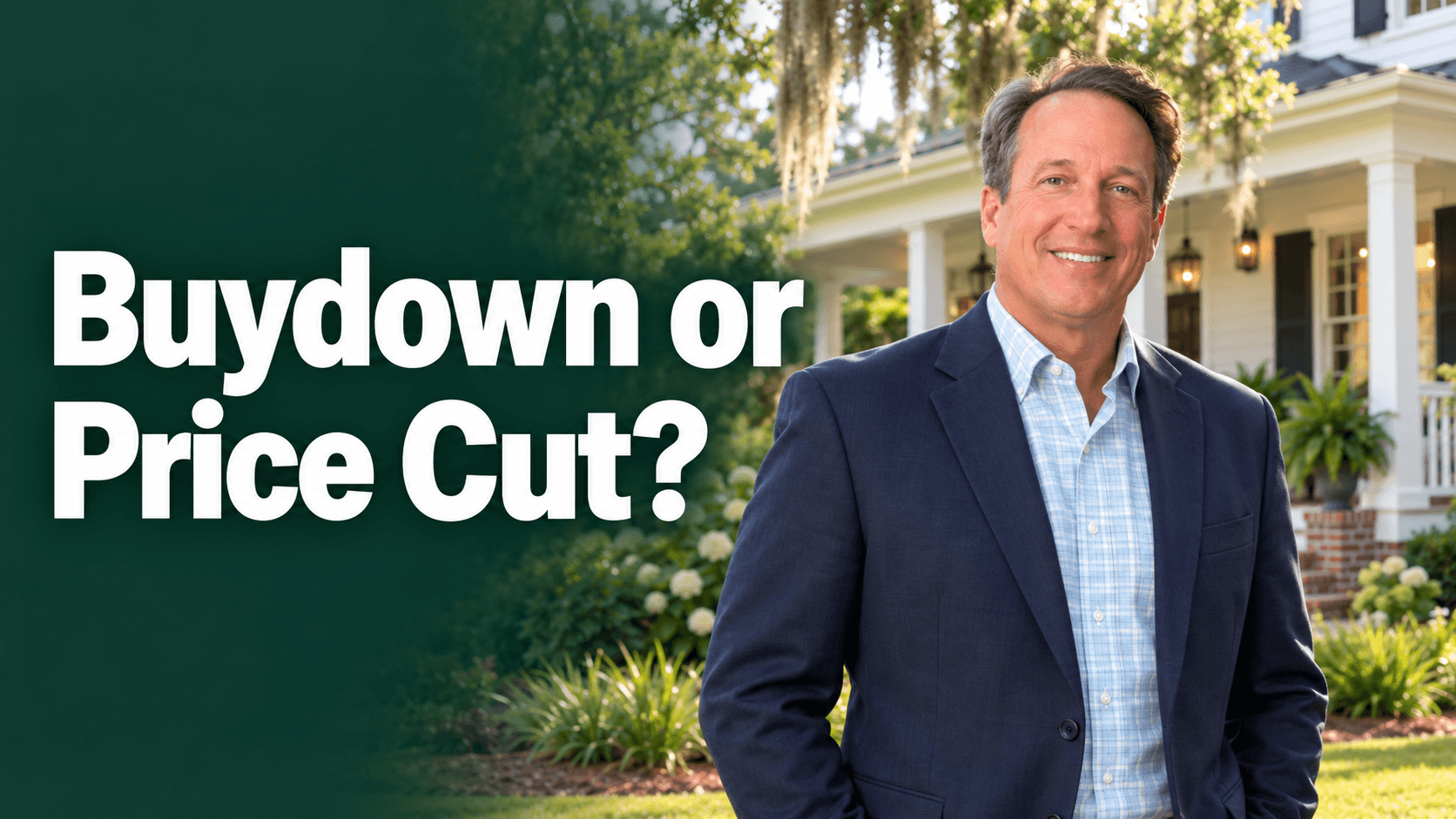
Ask the seller to help lower your loan payment
TLDR: On the $400,000 loan below, a 2-1 buydown brings your first-year loan payment from about $2,661 to about $2,147. That's about $514 less each month. If the seller uses the same roughly $9,323 to cut the price instead, your payment would be about $2,599, about $62 less each month.
The buydown gives you more breathing room now. The price cut means you borrow less.
These numbers are principal and interest: the loan payment before taxes and insurance. Your actual payment will be greater with taxes and insurance. Mortgage insurance, HOA dues and fees may also apply.
The numbers we're using
- Purchase: $500,000 home with $100,000 cash down, leaving a $400,000 loan.
- Loan: 30-year fixed term at a hypothetical 7.00% note rate, not today's verified rate.
- Full loan payment: $2,661.21 a month before taxes and insurance.
The seller's one-time buydown contribution is money set aside to cover part of your mortgage payments. You pay the rest while that help lasts. The actual rate and loan terms stay unchanged under the written buydown agreement.
Illustrative only, not a commitment to lend. Actual payments will be greater with taxes and insurance. Mortgage insurance, HOA dues and fees may also apply. Lender pricing can vary.
What do you pay with a 2-1?
In the first year, your payment is calculated as if the rate were 5.00%, two percentage points below 7.00%. Your mortgage rate stays at 7.00%; the seller's money covers the difference. In the next year, you pay as if the rate were 6.00%. Starting in year three, you pay the full amount.
2-1: your loan payment over time
Year 1 · months 1–12
Save $513.92 a month
$6,167.04 less paid over these 12 months.
Year 2 · months 13–24
Save $263.01 a month
$3,156.12 less paid over these 12 months.
Years 3–30 · months 25–360
Temporary savings end
What the buydown costs: $9,323.16. The seller pays this once.
Your total payment savings: $9,323.16 over 24 months. The seller's money covers these payment differences; it does not reduce your starting loan balance.

What changes with a 3-2-1?
The seller pays more upfront, so you get a lower starting payment and another year of help. Ask whether that extra help is worth the extra seller money, especially if you also need help with closing costs.
What do you pay with a 3-2-1?
Your first-year payment is calculated as if the rate were 4.00%. It then goes up as if the rate were 5.00%, then 6.00%. The actual mortgage rate stays at 7.00% throughout. Starting in year four, you pay the full amount.
3-2-1: your loan payment over time
Year 1 · months 1–12
Save $751.55 a month
$9,018.60 less paid over these 12 months.
Year 2 · months 13–24
Save $513.92 a month
$6,167.04 less paid over these 12 months.
Year 3 · months 25–36
Save $263.01 a month
$3,156.12 less paid over these 12 months.
Years 4–30 · months 37–360
Temporary savings end
What the buydown costs: $18,341.76. The seller pays this once.
Your total payment savings: $18,341.76 over 36 months. The seller's money covers these payment differences; it does not reduce your starting loan balance.
Monthly loan payments round to cents before the differences are added across each year. Rounded TLDR figures are labeled as approximate; charts show exact cents.
Which choice fits what you need?
- Need help with payments now? A buydown puts the seller's money toward the opening years. Compare the total help over two or three years, and make sure the full payment fits without refinancing.
- Want to borrow less? A price cut lowers starting debt immediately and your ongoing loan payment. That can matter more if you want a lower balance or expect to keep the loan beyond the buydown years.
- Need cash for moving or repairs? Ask about closing-cost help. If you expect to keep the loan longer, compare permanent points too.
Which seller-paid option fits your purchase?
Send the property, price, cash down payment, intended use and proposed seller credit. Ask Beaufort Lending to compare the early payment, full payment and cash due at closing.
Submit Your ScenarioBuyer checklist: start with the full payment
- Qualify at the note rate. Freddie Mac and Fannie Mae require this. Early help is not a shortcut to approval.
- Add the property's costs. Confirm taxes, insurance, mortgage insurance and HOA dues. Coastal buyers should obtain wind and flood estimates when needed. South Carolina's insurance department notes that standard homeowners policies typically exclude flood.
- Plan without a refinance. Future rates, home value, costs and approval are uncertain. Ask how unused buydown funds are handled under the signed agreement and program rules if you sell or refinance early; do not assume a refund.
Seller checklist: confirm the complete credit
- Seller cooperation is negotiated, not guaranteed. Check how the proposed concession affects your proceeds.
- The contribution must fit the loan's limits alongside other seller-paid costs. Fannie Mae's contribution rules show why the lender must review the full credit.
- Confirm lender availability and the funding agreement before finalizing the offer.
The property and program still matter
Fannie Mae and Freddie Mac exclude investment-property and cash-out loans from their temporary buydown plans. Investor or DSCR financing needs a separate comparison. HUD's FHA guidance and the VA FAQ discuss both structures for eligible transactions. Program permission does not guarantee lender availability or your approval.
Sources and calculations reviewed October 4, 2026. Beaufort Lending must confirm the selected lender, loan and property requirements.
Compare your options with Beaufort Lending
Benji Gecy and the Beaufort Lending team can compare a buydown, price reduction and other eligible uses of the same seller budget for your actual South Carolina purchase. Ask how each choice affects your payments during the buydown, debt, cash due at closing and full payment afterward. The buydown calculator is a planning tool; request a lender-reviewed quote before negotiating.
Comparing a seller's offer?
Choose the concession that fits your purchase
Send the property, intended use, cash down payment and seller credit. Beaufort Lending can help you compare the same seller budget against your cash needs and how long you expect to keep the loan. Submit your scenario, call or text to discuss the options available for your purchase.
Benji Gecy, NMLS #302188 · Beaufort Lending, NMLS #1703543 · Equal Housing Lender
Other resources you may find helpful