
The right South Carolina mortgage broker compares the complete loan, not just the rate
Updated September 30, 2026
The right mortgage professional should hold an active South Carolina license, understand your income and property type, explain compensation clearly, and show the complete cost of the loan. Start by verifying the license, then compare written Loan Estimates using the same purchase details on the same day.
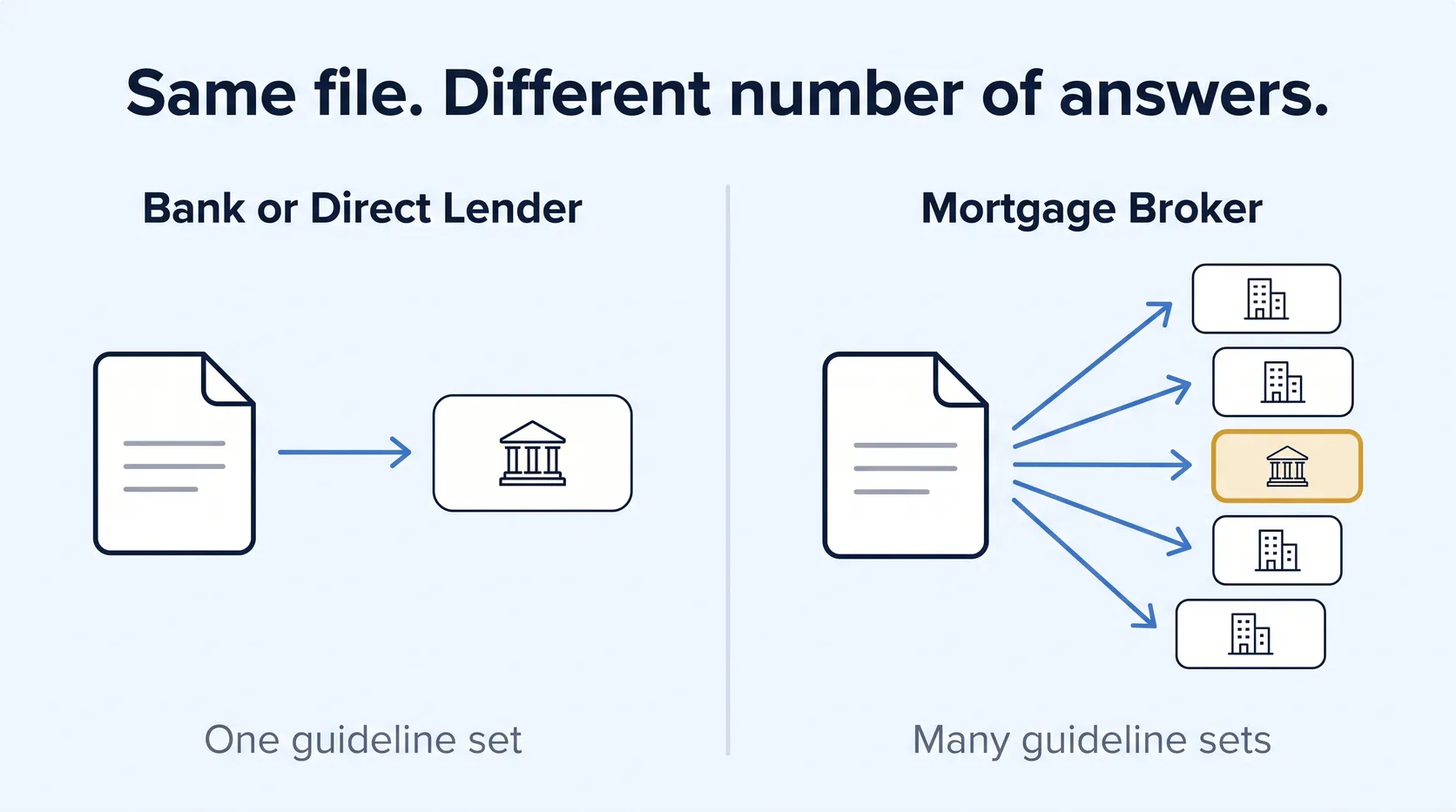
A broker can compare programs from multiple wholesale lenders. A bank or direct lender generally offers its own programs. Any of them may be a good fit, but the difference becomes important when you are self-employed, buying a rental or condo, using VA financing, building a home, or trying again after a decline.
Seven checks to make before choosing a mortgage broker
- Verify the individual and company licenses. Use NMLS Consumer Access to confirm that both records are active in South Carolina before sending private financial records.
- Ask how many lenders can review your file. A broker may work with several wholesale lenders. Ask for a specific answer and whether those lenders handle your income and property type.
- Confirm experience with your situation. Name the issue that could affect approval: self-employment, military relocation, a condotel, renovation work, a rental, or a prior decline.
- Compare written Loan Estimates on the same day. Use the same property, price, down payment, occupancy and lock period so every company is pricing the same request.
- Read the rate, fees, payment and cash to close together. A lower rate may require points. A lender credit may reduce upfront cash while increasing the rate.
- Ask what could still change. A useful answer should identify appraisal, property, insurance, income, credit and rate-lock risks before closing.
- Know who will solve problems after you apply. Ask who communicates with underwriting and who is available when the appraisal, title, insurance or closing schedule raises a question.
A useful mortgage comparison also covers points, lender fees, credits, the complete monthly payment, cash to close, the rate-lock period and the issues that could still affect approval.
Mortgage broker, bank or direct lender: what changes?
A mortgage broker compares wholesale lenders
A broker can submit an application to multiple wholesale lenders and match it with an available program. This can help when lenders calculate self-employed income differently or apply different rules to a rental, condo, condotel, renovation or construction project.
A bank or credit union offers its own programs
A bank gives you that institution's programs and loan rules. This may work well for a straightforward application, and an existing banking relationship may be useful. If the bank declines the loan, ask whether the issue comes from a broad program rule or a bank-specific restriction.
A direct or online lender makes its own credit decision
A direct lender funds the mortgage through its lending operation. Ask who reviews the file, how property problems are handled, and what alternatives remain if an appraisal comes in low or a condo project does not meet the first program's rules.
| Company type | What it can compare | Where it may help | Question to ask |
|---|---|---|---|
| Mortgage broker | Programs from multiple wholesale lenders | Self-employed income, rentals, condos and specialized properties | How many lenders can review my exact situation? |
| Bank or credit union | Its own programs | Straightforward applications and existing relationships | What happens if my file does not fit this program? |
| Direct lender | Its own lending programs | Standard files where its pricing and process are competitive | Who underwrites the loan and handles exceptions? |
How to compare Loan Estimates without being distracted by one number
The Consumer Financial Protection Bureau recommends comparing Loan Estimates issued on the same day because mortgage rates can change daily. Review the interest rate, annual percentage rate, monthly principal and interest, mortgage insurance, total payment, Section A origination charges, lender credits, cash to close and the five-year cost shown on page 3.
Pay special attention to costs the lender controls. A lower tax or insurance estimate does not make one lender cheaper because the lender does not set those bills. Ask why the lender charges, points and credits differ.
A simple points-versus-credits example
This simplified example is not a current quote. It shows how choices for the same hypothetical mortgage can trade upfront cash for monthly payment.
| Hypothetical choice | Cash at closing | Monthly principal and interest | What to consider |
|---|---|---|---|
| No points or lender credit | Baseline | Baseline | A middle option for comparison |
| $4,000 in hypothetical points | $4,000 more | $85 less | About 47 months to recover the added upfront cost |
| $2,500 hypothetical lender credit | $2,500 less | $70 more | More cash preserved now, with a higher ongoing payment |
CFPB defines points as an upfront fee paid for a lower rate and lender credits as a rebate that may come with a higher rate. Ask each company to show the same option with and without points or credits, then calculate the break-even period using your actual figures.
Want a complete comparison for your purchase?
Send the property, price, down payment, intended use and how your income is documented. We can review the available programs and explain the likely differences in upfront cash, monthly payment and property review.
Submit Your ScenarioHow to verify a South Carolina mortgage license
Start with the loan officer's name and NMLS ID, then search the individual and the company on NMLS Consumer Access. Confirm that South Carolina appears as an active license and review employment history and any regulatory actions.
The South Carolina Department of Consumer Affairs explains that mortgage brokers file under the Mortgage Broker Act through NMLS. Mortgage lenders and servicers operate under the Mortgage Lending Act through the State Board of Financial Institutions. Licensing information was reviewed September 30, 2026.

When access to specialty mortgage programs can help
Standard conventional, FHA, VA and USDA financing should be considered when the borrower and property fit those rules. A specialty or non-QM program may help when standard paperwork does not tell the full story, but it should be compared with every standard mortgage the borrower can use.
- Self-employed income: a bank statement loan may calculate eligible income from business or personal deposits when tax returns understate cash flow.
- Rental properties: a DSCR loan may qualify an eligible investment property primarily through its rent instead of employment income.
- Specialized condos: condotels and non-warrantable projects may need portfolio or non-QM financing when they do not meet standard project rules.
- Loans above the conforming limit: jumbo financing has its own credit, available-cash and property requirements.
- A prior decline: ask whether the decision came from a broad program requirement, a lender-specific restriction or missing information.
Local South Carolina property issues can change the mortgage choice
A statewide license allows one mortgage professional to serve buyers across South Carolina, but local property conditions still change the work. Charleston's older homes can raise repair, permit and insurance questions. Myrtle Beach and Hilton Head Island condos can require a detailed HOA and project review.
Beaufort and Parris Island buyers often need VA experience and careful relocation timing. Greenville construction and renovation files can require builder, land and draw-schedule review. Around Columbia and rural counties, an exact address can determine whether USDA financing is available.
Frequently asked questions
Is a mortgage broker cheaper than a bank in South Carolina?
A broker is not automatically cheaper than a bank. Compare Loan Estimates using the same loan details on the same day. Focus on lender-controlled charges, credits, payment, cash to close and the five-year borrowing cost instead of choosing by rate alone.
Do mortgage brokers charge a fee?
Broker compensation is disclosed on the Loan Estimate. Federal rules prohibit compensation from both the consumer and another party on the same transaction. Ask whether the loan uses borrower-paid or lender-paid compensation and how that choice affects the rate and upfront costs.
How many mortgage companies should I compare?
Multiple Loan Estimates give you a useful comparison; three is a practical starting set, not a legal requirement. CFPB says mortgage credit checks made within a 45-day shopping window are recorded as a single inquiry.
Can one broker handle purchases across South Carolina?
A company and loan officer with active South Carolina licenses can handle eligible purchases statewide. The important difference is local experience with coastal insurance, condo projects, rural eligibility, military relocation, renovations and construction.
Why borrowers use Beaufort Lending for a second look
Benji Gecy launched his mortgage career in 1997 and works with buyers, homeowners and investors across South Carolina. Beaufort Lending reviews the income, property, occupancy, available cash and timing before comparing the programs that may fit.
The goal is a usable comparison: what each option may require, how it changes upfront cash and monthly payment, and which risks need attention before closing. Reviews from South Carolina borrowers load below so you can read their experiences directly.
Ready to compare the complete loan?
Choose with the full numbers in front of you
Send the property, price, down payment, occupancy and income type. We will review the available programs and explain the useful tradeoffs.
Benji Gecy, NMLS #302188 · Beaufort Lending, NMLS #1703543 · Equal Housing Lender
Other resources you may find helpful
- Compare South Carolina mortgage programs
- Use the mortgage calculator tools
- Review South Carolina jumbo financing
Shopping for a home in Beaufort or the Lowcountry?
Browse local homes for sale on Discover Lowcountry Life, where Christy and Kathy Gecy help buyers explore Beaufort-area properties and communities.
Real estate disclosure: Discover Lowcountry Life is an independent real estate website featuring local homes for sale and real estate services from Christy and Kathy Gecy, a local real estate team. You may work with any real estate professional or mortgage provider you choose. Using Discover Lowcountry Life is not required to obtain financing from Beaufort Lending and does not affect your loan terms, costs, or approval.